Triana Bridge, Seville: Evening on the Guadalquivir
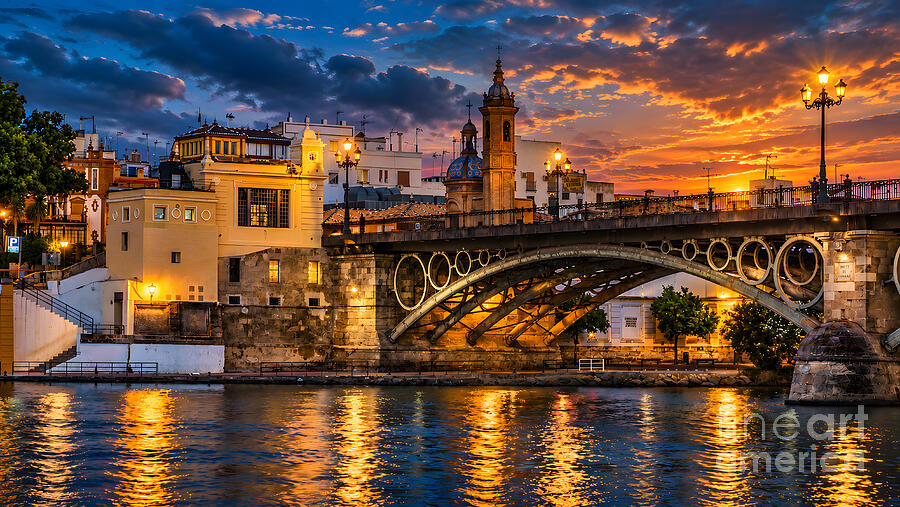
The iron arch of the Triana Bridge spans the frame from the stone pier on the right to the embankment wall on the left, and the rings that fill its spandrels catch the light like a row of coins. Lamps are lit along the parapet. Behind the bridge, the bell tower and tiled dome of the Capilla del Carmen stand against the evening sky, and every lit window on the far bank throws a gold stripe down into the water. Nothing moves except the river. The city has switched on its lights, and the water keeps them. This first image is an interpretation with a sunset sky; the photograph it grew from, taken at blue hour, appears further down.
🖼️ Get this photo as a print →
The bridge's official name is the Puente de Isabel II, after the queen in whose reign it was finished in 1852, but in Seville almost nobody calls it that. It is the Puente de Triana, named after the district it reaches. For more than six centuries before it, the only crossing here was a bridge of boats chained together, first laid by the Almohads in 1171. The iron bridge was designed by the French engineers Fernando Bernadet and Gustavo Steinacher, who drew on the example of the Pont du Carrousel in Paris. It is the oldest iron bridge still standing in Spain, and in 1976 it was declared a national historic monument.
The river here is Seville's seam. On the east bank lies the historic centre, with the cathedral, the Arenal and the old bullring a few streets away. On the west bank is Triana, the neighbourhood of potters, sailors and flamenco singers, whose tile workshops supplied the ceramics seen all over the city. The chapel at the Triana end of the bridge, the Capilla del Carmen, was designed by the architect Aníbal González and finished in 1928. With its brick tower and blue-and-white dome, it works as a gateway: cross the bridge, pass the chapel, and you are in the Plaza del Altozano, the front door of Triana.
The arches no longer carry the full weight of the traffic. During a restoration that began in 1976, the old deck was replaced by a new self-supporting one resting directly on the piers, so the ironwork could be kept. What the city preserved, in the end, was the shape: three shallow arches and their rings, the outline that appears on postcards, azulejos and souvenir plates across Seville.
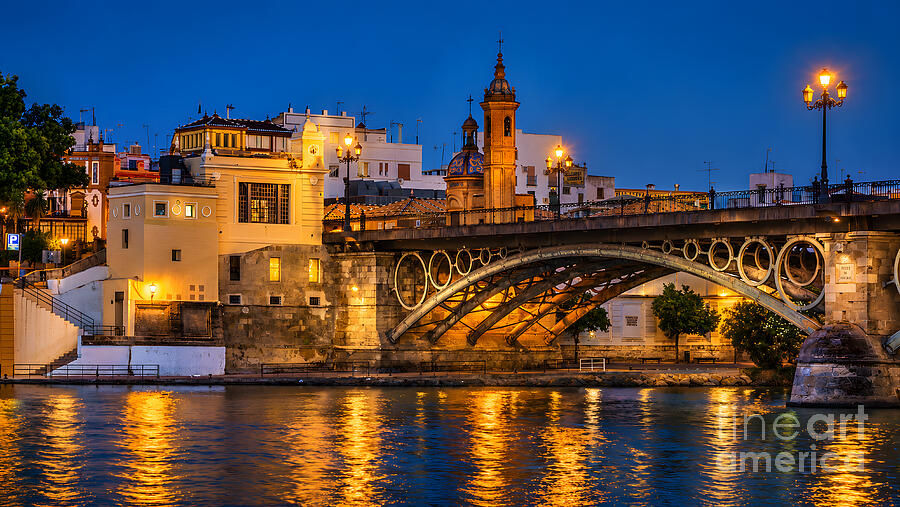
The original photograph, shown further down, was taken from the water's edge at the moment when the sky and the artificial light are in balance. The blue is deep enough to make the lamps glow, but there is still enough daylight to read the stone of the pier, the rivets of the arch and the texture of the embankment wall. The river does most of the work. Its surface breaks the reflections into short vertical strokes, so the whole lower half of the frame becomes a pattern of gold on dark blue, repeating the lights above.
Photographer: Sapiens Verbum
Subject: The iron arch of the Triana Bridge at dusk, with the Capilla del Carmen and lamplight reflected in the river
Location: Puente de Isabel II (Triana Bridge), Seville, Andalusia, Spain
Medium: Colour photograph and an interpretation of the same frame
Series: Andalusia
The photograph behind it
This is the frame as the camera recorded it, at blue hour, with the sky gone fully blue. The interpretation above keeps the same bridge, chapel and river and replaces the blue hour with a sunset sky. The short video below moves from one version to the other so you can compare them.
Watch it on @RelaxingTrails4K on YouTube.
See more of Seville in motion
If this frame makes you want to walk along the river yourself, these longer videos from our travel channel cover the same city at street level:
- Seville by night: a 4K walking tour through the old city (43 min)
- A drive through Seville in 4K (29 min)
- The road from Cádiz to Seville through Andalusia (25 min)
For another view of Seville, see rowing boats on the canal of the Plaza de España, the square Aníbal González designed for the 1929 Ibero-American Exposition.
Both versions of this frame are available as museum-quality prints, canvas or posters, and the photograph can also be licensed for your next project.
Buy the Interpretation Buy the Photograph License Photograph
See the Puente de Isabel II on Google Maps
Part of the Andalusia series.
Comments
Post a Comment