Combarro at Dusk, Galicia — Photograph, Watercolor & Art Nouveau Poster
Combarro is one of those places where land and sea seem to have been designed together. On the shore of the Ría de Pontevedra, this historic Galician fishing village gathers granite houses, red-tiled roofs, traditional waterfront architecture and hórreos above the tidal shoreline, creating one of the most distinctive coastal landscapes in Galicia.
This post presents the same Combarro scene in three different forms: first, a Belle Époque-inspired Art Nouveau travel poster; second, a fine-art watercolor interpretation; and finally, the original photograph by Sapiens Verbum. Three treatments, three moods, but one unmistakable landscape.
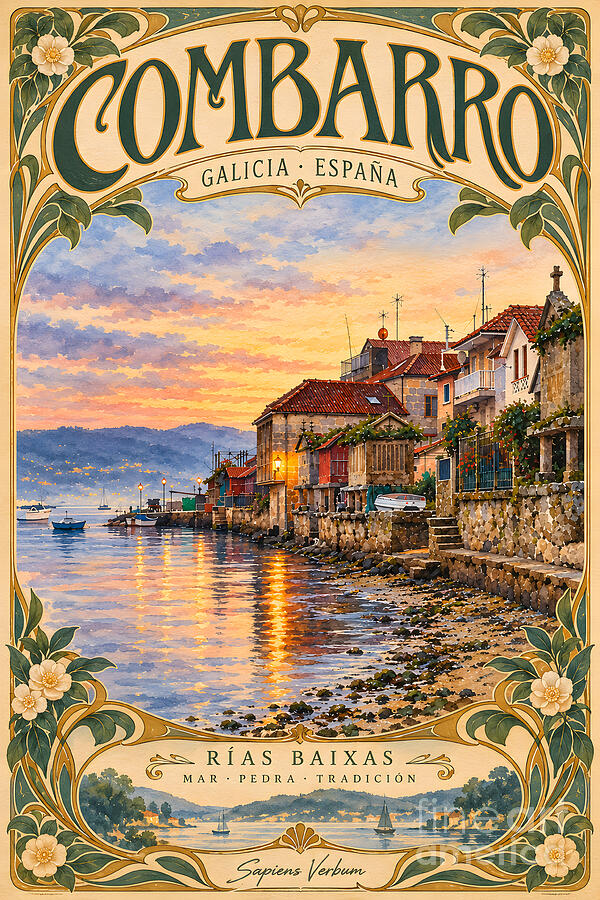
The Art Nouveau travel poster
The first interpretation turns the Combarro waterfront into a sophisticated early-20th-century travel poster. The original landscape remains the structural foundation: the shoreline, houses, boats, distant hills and tidal water retain their essential relationships, while the photographic scene is transformed through watercolor-like washes, a restrained Belle Époque palette, organic curves and botanical ornament.
The decorative frame is inspired by the language of European Art Nouveau travel posters, with flowing lines, leaves, floral forms and elegant period lettering surrounding the central landscape. Rather than simply placing a frame around the image, the ornament becomes part of the composition, turning the scene into one unified piece of graphic art.
🖼️ Get this poster as a print → License Artwork
Quick facts
Location: Combarro, Poio, Pontevedra, Galicia, Spain
Setting: Ría de Pontevedra, Rías Baixas
Subject: Historic seaside village at dusk and low tide
Original photograph: Sapiens Verbum
Artistic interpretations: Sapiens Verbum
Works: Art Nouveau travel poster · Fine-art watercolor · Original photograph
The watercolor behind the poster
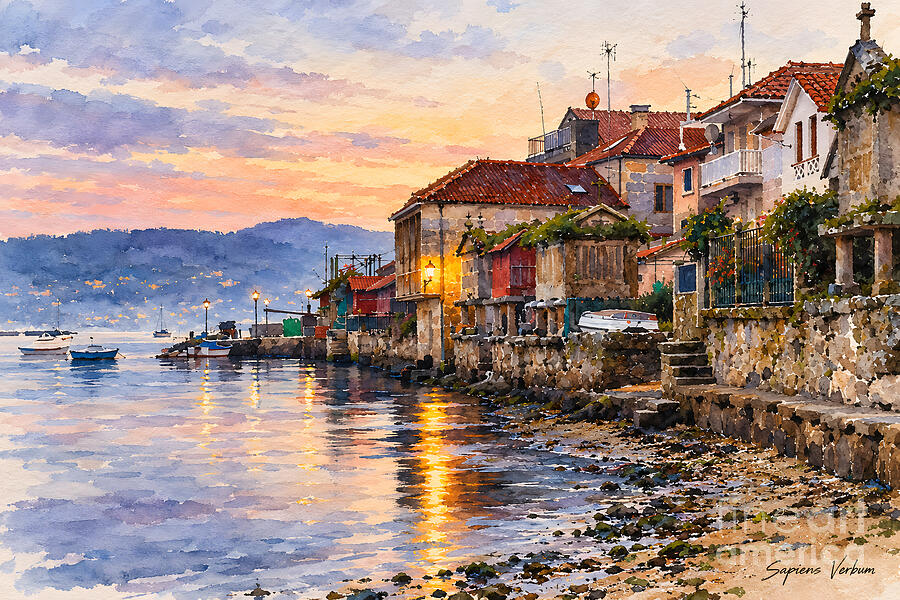
The second version explores the same view through the language of traditional watercolor. Transparent washes, layered pigment, softened edges and atmospheric transitions turn the evening landscape into something quieter and more painterly. The distant hills dissolve into cool tones, while the warm lights along the waterfront create delicate reflections across the estuary.
The intention is not photographic imitation. It is to preserve the identity of Combarro while allowing watercolor to express what the camera records less directly: atmosphere, silence, reflected light and the changing character of the Atlantic landscape.
🖼️ Get this watercolor as a print → License Artwork
The original photograph
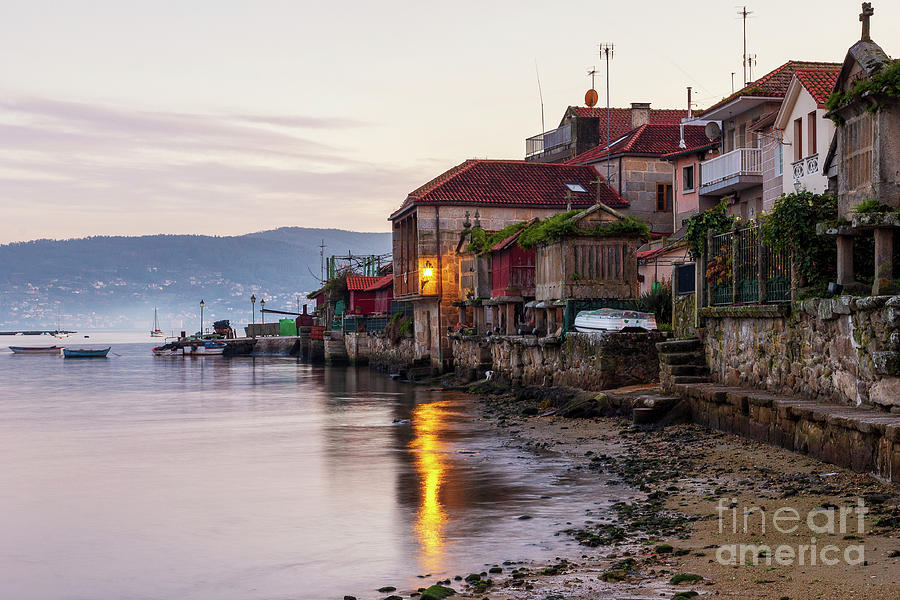
Everything begins with the photograph by Sapiens Verbum. Taken at dusk and at low tide, it captures Combarro as it actually appears: a calm estuary in the foreground, exposed rocks along the shoreline, traditional buildings rising behind the waterfront and the final light of the day settling over the distant hills.
The photograph is the documentary foundation of the other two works. The poster changes the graphic language. The watercolor changes the medium. The place itself remains Combarro.
🖼️ Get the original photograph as a print → License Photograph
Three versions of the same shore
Seen together, the three works tell a simple visual story. The photograph records the place. The watercolor interprets its light and atmosphere. The Art Nouveau poster transforms the same landscape into a decorative travel image, inspired by the great European poster tradition of the Belle Époque.
Combarro is especially suited to this approach because its character is already strongly visual: granite walls, tiled roofs, boats, hórreos, narrow waterfront spaces and the changing surface of the estuary create a composition that works equally well as documentary photography, painting or poster art.
Combarro Art Nouveau Travel Poster →
Combarro at Dusk — Watercolor →
Combarro at Dusk — Original Photograph →
Combarro and the tide
The relationship between Combarro and the water is fundamental to the character of the village. At low tide, the shoreline changes dramatically, exposing rocks and stone edges that disappear beneath the water at other times. That changing geometry gives the waterfront a different visual character throughout the day and is particularly striking at dusk, when the cool tones of the sky contrast with the warm lights of the houses.
The result is a landscape that feels both timeless and constantly changing: the architecture remains, while the light, tide and reflections continually redraw the scene.
Seeing Combarro today
Combarro forms part of the municipality of Poio, in Pontevedra, Galicia, on the Ría de Pontevedra. Its historic quarter is known for its traditional granite architecture, fishing heritage, hórreos and cruceiros, preserving an unusually coherent example of the traditional character of a Galician coastal settlement.
For photographers, painters and travellers, the village offers an exceptional combination of architectural detail, maritime atmosphere and Atlantic light. It is a place that rewards returning at a different hour, under a different sky or with a different tide.
Bring Combarro to your wall through three different interpretations of the same Galician shore.
 Buy Fine Art Print
License Artwork
Buy Fine Art Print
License Artwork
 Buy Fine Art Print
License Artwork
Buy Fine Art Print
License Artwork
 Buy the Original Photograph
License Photograph
Buy the Original Photograph
License Photograph
Browse the full collection →
Printed and shipped by Fine Art America · 30-day money-back guarantee
Which version captures Combarro best: the documentary photograph, the watercolor or the vintage travel poster?
Sources
Turismo de Poio — Combarro Historical Site
Turismo de Galicia — Combarro
Spain.info — Combarro
Comments
Post a Comment