Playa de la Magdalena, Cabanas, c. 1900-1930: Photograph and Interpretation
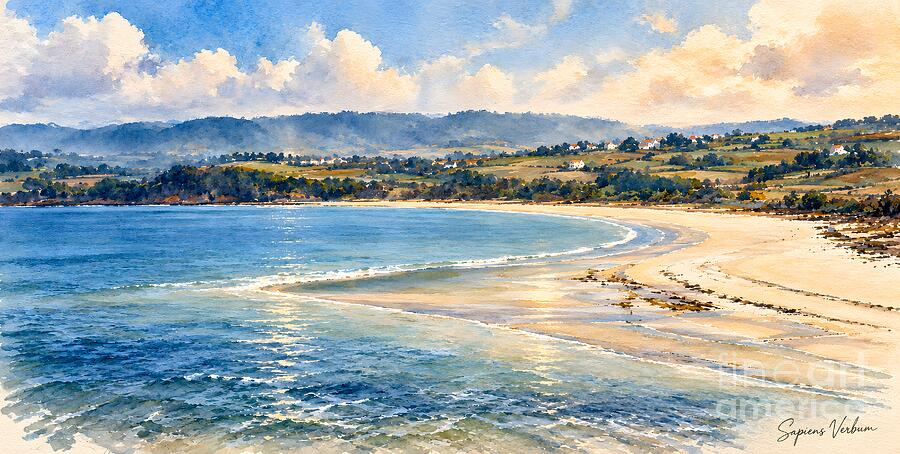
A long, pale crescent of sand curves away into the distance, the water of the ría lies calm and shallow along its edge, and behind it a low line of trees gives way to fields, scattered white farmhouses and hills fading into haze. There is not a parasol or a beach bar in sight. This is Playa de la Magdalena, the great beach of Cabanas at the mouth of the river Eume, as it appeared on a postcard sold as a souvenir of Pontedeume sometime between 1900 and 1930. This first image is an interpretation, painted in loose watercolour washes; the old postcard it grew from is described further down.
🖼️ Get this photo as a print →
Original photograph: Photographer not named, c. 1900–1930 (postcard no. 16, Fototipia Thomas, Barcelona)
Interpretation: Sapiens Verbum
Subject: The sweep of Playa de la Magdalena at the mouth of the Eume, as seen on an early 20th-century postcard of Pontedeume
Location: Praia da Madalena, Cabanas, A Coruña, Galicia, Spain (across the Eume from Pontedeume)
Medium: Watercolour interpretation of a public-domain postcard photograph
Series: Pontedeume
The watercolour keeps the postcard’s wide view and its quiet. The sand becomes a warm band of cream and gold, wet in places where the tide has just pulled back and dotted with dark patches of weed and stone. The water shifts from turquoise near the shore to a deeper blue further out, the trees behind the beach are dabbed in dark greens, and the farmland on the slopes is laid in patches of olive and ochre beneath tall, sunlit clouds. Black and white has become a summer afternoon, but the shape of the bay, the line of the hills and the emptiness of the beach are those of the old card.
A Pontedeume postcard of a Cabanas beach
The card is captioned Puentedeume. Playa de la Magdalena, yet the beach lies in the municipality of Cabanas, on the far bank of the Eume. To a postcard publisher and to the visitors who bought these cards, that made perfect sense. The sand faces Pontedeume across the river mouth, and the old town, with its tower and its long stone bridge, was the place people knew and came to see. The bridge itself, rebuilt between 1863 and 1870 and given its present fifteen arches in the 1880s, was the everyday link between the two banks, so a stroll from Pontedeume to the Magdalena meant a walk across the Eume.
The decades when this card was printed were also the years when sea bathing was turning into a summer habit on the Galician coast. In nearby A Coruña, beaches lined with bathing huts were already drawing summer visitors at the start of the twentieth century. A beach like the Magdalena, sheltered at the head of the ría with calm, shallow water, was exactly the kind of place a souvenir album wanted to show.
Sand, rails and pines
The beach in its modern form owes a great deal to the railway. The line between Betanzos and Ferrol, known as O Ramalillo, crossed the Eume here on an iron bridge 151 metres long, built around 1910. Trains began running provisionally in February 1912, and the line was officially opened on 5 May 1913. An information panel at the beach explains that the railway embankment cut the old sandspit off from the estuary and narrowed the mouth of the Eume to the passage under the iron bridge, and that these changes led to a large build-up of sand in the early years of the twentieth century where the beach and the pinewood stand today.
That pinewood is the other half of the Magdalena’s identity. Planting began in 1914, in a reforestation carried out over the first third of the century both for timber and to shelter the farmland behind the dunes. Today the Piñeiral da Madalena covers about nine hectares, with more than a thousand trees, mostly maritime and Monterey pines, alongside oaks and some large cork oaks. Depending on when the photographer set up the camera, the trees behind the sand on this card may be among the very first to grow there.
The photograph behind it
The source is postcard number 16 in an album published by Fototipia Thomas of Barcelona, Recuerdo de Puentedeume y sus alrededores. Album n.º 2. The Thomas firm, founded by the printer Josep Thomas i Bigas, produced collotype view albums of towns all over Spain, and like most of them this one does not name the photographer. The card is preserved by the Biblioteca de Galicia and can be seen in its digital library, Galiciana (shelfmark POS 1485), where it is catalogued as a public-domain work and dated broadly to between 1900 and 1930. The interpretation above keeps the postcard’s shoreline, bay and hills, and changes the colour, the light and the touch.
Visiting Praia da Madalena today
The beach is a short walk from Pontedeume: cross the stone bridge to Cabanas and follow the waterfront promenade past the blue iron railway bridge to the sand, where a breakwater channels the mouth of the Eume. The sand runs for about 1,100 metres, around 50 metres wide, white and fine, with calm, shallow water that makes it a favourite with families. In summer there are lifeguards, beach bars and wooden boardwalks, and the pinewood behind the beach has picnic tables and shady paths where red squirrels and wood pigeons are often seen. From the southern end the view runs straight across the water to Pontedeume and the Torreón dos Andrade. Stand near the waterline, look along the curve of the bay towards the hills and you can still line up the view on the old card.
See more of the Ría in motion
Our travel channel has filmed the roads around Cabanas and Pontedeume:
- A drive from Ares to Cabanas and Fene in 4K (64 min)
- A drive through Ares, Mugardos, Cabanas, Pontedeume and Fene in 4K (94 min)
For another scene from early twentieth-century Pontedeume, see the Tree Festival in Praza do Conde, c. 1914. The stone bridge that links the town with Cabanas appears in Pontedeume’s medieval stone bridge by night, and the Ría de Ares from the slopes above the beach in the Ares estuary at dusk from Cabanas.
See the Magdalena as it looked a century ago framed on your wall. This watercolour interpretation is available as a museum-quality print, canvas or poster, and it can also be licensed for your own project.
 Buy Fine Art Print
License Photograph
Buy Fine Art Print
License PhotographPrinted and shipped by Fine Art America · 30-day money-back guarantee
See Praia da Madalena on Google Maps
Part of the Pontedeume series.
Comments
Post a Comment