Yellow-Legged Gull Fishing an Eel: A Classic Natural History Engraving
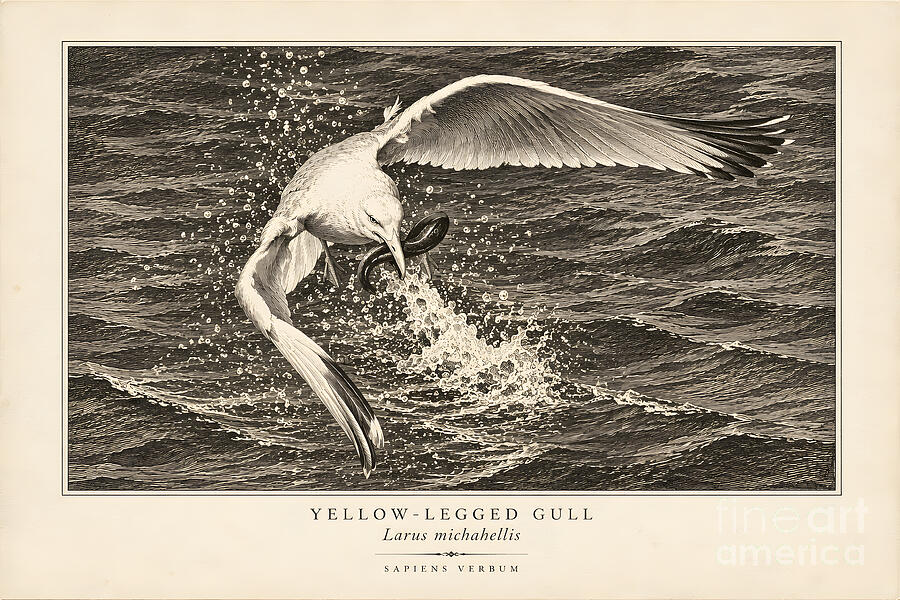
A gull drops onto a choppy sea, wings thrown wide, tail twisted down, and comes up with an eel coiled in its bill while the spray bursts around it in a fountain of droplets. It is a split second of hunting, held still in fine black lines on cream paper. This print renders the moment in the manner of a classic natural history engraving: a ruled border, a sea built from hundreds of parallel strokes, and a plate caption in small capitals that names the bird the way an old field guide would, YELLOW-LEGGED GULL, Larus michahellis.
🖼️ Get this engraving as a print →
A bird, held as an engraving. Most of the pictures on this blog are photographs or posters. This one borrows the language of the plates in nineteenth-century natural history books, where birds were drawn, engraved and printed in black line before colour photography existed. The result is not a scientific plate and does not pretend to be one. It is an interpretation of a real moment, seen from the old stone bridge of Pontedeume, in Galicia, where the river Eume meets the sea: a modern moment of hunting, told in an old visual language.
Subject: Yellow-legged gull (Larus michahellis) catching an eel
Location: Puente de Piedra, Pontedeume, Galicia, Spain
Family: Laridae (gulls)
Range: Mediterranean and the Atlantic coasts of southern Europe and north-west Africa, spreading north in recent decades
Size: About 52–68 cm long, wingspan about 120–155 cm
Conservation status: Least Concern (IUCN)
Interpretation: Sapiens Verbum
Work: Classic natural history engraving
The bird
The yellow-legged gull is the big gull of the Mediterranean and of the Atlantic coasts of Spain and Portugal. Adults have a pale grey back, a little darker than a herring gull’s, black wingtips with white spots, a strong yellow bill with a red spot near the tip, and, as the name says, bright yellow legs. For a long time it was treated as a form of the herring gull; today most authorities, including the IUCN, recognise it as a species of its own.
It is a bold, adaptable bird. It feeds on fish and other marine animals, follows fishing boats, scavenges in harbours and rubbish tips, and raids the nests of other seabirds. It nests on cliffs, islands and, more and more, on city rooftops. In many southern European towns it is the bird you hear first in the morning.
The moment
An eel is a slippery prize. In the engraving the gull has just snatched it from the surface and is lifting away, the eel looped around its bill, the wings and tail twisting to keep balance. Gulls usually feed by picking food from the surface or making shallow plunges rather than true dives, and this is exactly that kind of strike: a fast drop, a grab, and a climb before the next wave. The splash rising behind the bird is the clock of the picture. A fraction of a second later it would be gone.
Why an engraving
Before photography, natural history depended on engravers. Artists such as Thomas Bewick in England cut birds into wood with astonishing precision, building feathers, water and sky out of fine lines. That language still reads as calm, careful observation. Here it does something a photograph cannot: it slows the action down. The sea becomes a pattern of parallel strokes, the spray becomes a scatter of tiny white dots, and the gull, white against the dark water, becomes the clear centre of a plate you could imagine bound into a Victorian book of British and European birds. The cream paper, the double ruled frame and the Latin name in italics complete the illusion.
This print belongs to our collection of engravings, which brings the same treatment to other birds and places, from the greater flamingo and the northern pintail to the harbour of Ferrol. You can browse it here: Engravings by Sapiens Verbum.
See the engravings collection →
Bring the yellow-legged gull and its eel to your wall as a classic natural history engraving from the Sapiens Verbum print shop.
 Choose your size and frame →
More engravings
Choose your size and frame →
More engravingsPrinted and shipped by Fine Art America · 30-day money-back guarantee
💬 Over to you: Do you see yellow-legged gulls where you live, on the coast or on the rooftops? Have you ever watched one hunt? Tell us in the comments.
More birds on this blog: Monk Parakeets on an Iron Fountain, Cádiz, and the full Birds label.
Sources
BirdLife International — Yellow-legged Gull species factsheet
Wikipedia — Yellow-legged gull
Sapiens Verbum — Yellow-Legged Gull Fishing an Eel, classic natural history engraving
Comments
Post a Comment