Ferrol Naval Hospital, 1902: Photograph and Interpretation
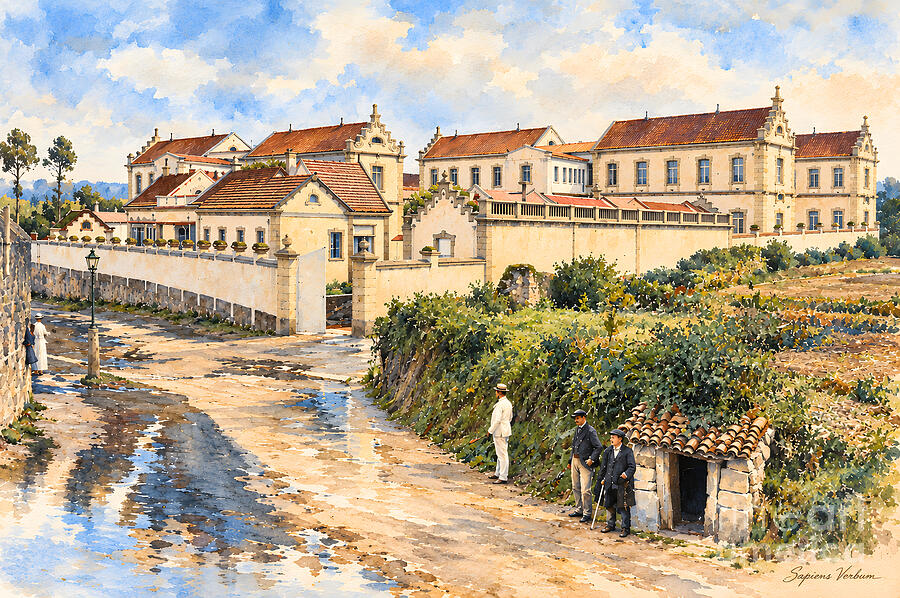
A rutted dirt road, still shining with puddles, curves past a long white wall with a single street lamp. Behind the wall rises a cluster of brand-new buildings: long pavilions with tiled roofs, carved gables and tall windows, joined by a balustraded gallery. In the foreground, beside a little stone hut roofed with curved tiles, three men have stopped to look at the camera. This is the new naval hospital of Ferrol, the Hospital de Marina, on a postcard published in 1902, the very year it opened. This first image is an interpretation, painted in loose watercolour washes; the old postcard it grew from is described further down.
🖼️ Get this photo as a print →
Original photograph: Photographer not named, 1902 (postcard published by Papelería de El Correo Gallego, series III, no. 7)
Interpretation: Sapiens Verbum
Subject: The new Hospital de Marina in the Esteiro district of Ferrol, seen from the road outside its walls, with three men in the foreground
Location: Former Hospital de Marina, now the Campus Industrial de Ferrol (University of A Coruña), Esteiro, Ferrol, A Coruña, Galicia, Spain
Medium: Watercolour interpretation of a public-domain postcard photograph
Series: Ferrol
The watercolour follows the postcard closely, from the curve of the road to the lamp post and the tiled hut, and turns a faded grey-brown print into a bright day after rain. The puddles on the road hold pieces of blue sky, the pavilions glow cream and honey under terracotta roofs, and their stepped gables stand out against tall, sunlit clouds. On the right, the rough slope of bushes and fields is dabbed in greens and ochres, and the three men, one in a pale suit and hat, two in dark coats with a walking stick between them, keep the same poses they struck for the photographer more than a century ago.
A hospital a century in the making
Ferrol had needed a proper naval hospital for a very long time. According to the University of A Coruña’s history of the site, the Navy began using an old bitumen store in Esteiro as a hospital in the early 1760s, under the squadron commander Jorge Juan. It was repaired and extended again and again, but its long, connected wards spread infection and it was never big enough. Plans for a new building came and went for lack of money, until a fire on 6 February 1891 badly damaged the old hospital. In the difficult years of the war in Cuba, the regent, Queen Maria Cristina, authorised a direct contract with the Société Nouvelle de Constructions Système Tollet of Paris.
The design was by the French military engineer Casimir Tollet. Work began in 1894, and on 16 July 1902 the new hospital, dedicated to Nuestra Señora de los Dolores, received its first patients. That date makes this postcard something of a news picture: published in 1902 and posted to Reims, in France, it shows the hospital in its very first months, with the ground outside its walls still raw and unpaved.
Pavilions that breathed
Tollet’s idea was to break the hospital up into separate pavilions instead of one large block, so that the sick could be kept apart and every ward could have light and fresh air. His signature was the pointed vault: the wards were roofed with tall ogival vaults designed to draw stale air up and out. It was one of the most advanced hospital designs of its time, built around light, fresh air and ventilation in the decades before antibiotics. According to the University, only two hospitals of this type were ever built in Spain, the one in Ferrol and San Juan de Dios in Madrid, which has since been demolished, and the Ferrol pavilions are considered among the finest examples of hospital architecture of their day in Galicia and Europe.
The complex kept growing after the photograph was taken. The last remains of the old hospital were pulled down in 1910, a large new medical pavilion with 300 beds was built on their site in the 1940s, and around the same time the architect Rodolfo Ucha designed a rationalist pavilion for officers whose plan follows the shape of a bastion of the old city wall. For most of its life the whole site was closed off from the street by walls almost four metres high.
Esteiro, Ferrol’s first workers’ quarter
The hospital stands in Esteiro, a district with a story of its own. Around 1750, when work began on the new royal shipyard on the inlet of Caranza, the slopes of Mount Esteiro were laid out as a new quarter to house the large workforce the works would need. It was the first district built from scratch in eighteenth-century Ferrol: six long parallel streets crossed by narrow lanes, with small houses that were first of wood and later of stone. For generations it was home to the families who worked in the shipyards and the naval base. Most of old Esteiro was demolished in the 1970s to make way for a wide new avenue and modern blocks; of the original streets, only Carlos III and part of Fernando VI survive.
From hospital to campus
The Navy built a new naval hospital elsewhere in the 1980s, and in 1990 the Ministry of Defence handed the old Esteiro site over to the city of Ferrol for university use. The patients and staff moved out, the city took charge of the buildings that October, and on 20 January 1992 it placed the old hospital at the disposal of the University of A Coruña. The university has since restored the pavilions and added new buildings around them, and the high walls that once sealed off the military compound have come down, opening the site to the neighbourhood. Since 2015 it has been known as the Campus Industrial de Ferrol, specialising in engineering, industry and design.
Many of the buildings on the card are still in use. Tollet’s pavilion number four, originally built for patients with syphilis, now holds the assembly hall and offices; pavilion two bis, once for surgery, houses research laboratories; the 1940s medical pavilion is home to the engineering school, where naval and ocean engineering is taught; and Ucha’s officers’ pavilion has become the Faculty of Nursing and Podiatry.
The photograph behind it
The source is a postcard titled El Ferrol. Nuevo Hospital de Marina, number 7 in series III, published in 1902 by the stationery shop of El Correo Gallego, the newspaper then published in Ferrol. It is a photogravure of 14 by 9 centimetres with an undivided back, printed with the words “Unión Postal Universal”. This copy was written on and posted from Ferrol to Reims, in France, and still carries its stamp and postmarks. The photographer is not named. The card is preserved by the Biblioteca de Galicia (shelfmark POS 491) and can be seen in its digital library, Galiciana, where it is catalogued as a public-domain work, described as a panoramic view of the naval hospital with three men in the foreground. The interpretation above keeps the postcard’s road, wall, pavilions and figures, and changes the colour, the light and the touch.
Visiting the old hospital today
The campus is open and woven into the streets of Esteiro, a short walk from the centre of Ferrol. Wander between the restored pavilions and look up at their gables and tall windows, then look for the stretch of the original 1894 perimeter wall that was kept when the rest came down: a bronze plaque on it remembers Casimir Tollet. Elsewhere in Esteiro, the eighteenth-century gate of the old shipyard still bears a carved royal coat of arms, and Carlos III street keeps a little of the old workers’ quarter. The muddy road and the fields of the postcard have long since been built over, but the pavilions themselves are unmistakable.
See more of Ferrol in motion
Our travel channel has walked the streets of Ferrol:
For another postcard from the same Ferrol publisher, see Ferrol’s central market in 1919, and for one from just outside the city, the Xubia bridge in 1906. The shipyards that gave Esteiro its reason to exist appear in the Ferrol estuary at dusk, and the whole ría in Ferrol’s ría at sunset from Monte Ancos.
Bring Ferrol’s brand-new naval hospital of 1902 to your wall. This watercolour interpretation is available as a museum-quality print, canvas or poster, and it can also be licensed for your own project.
 Buy Fine Art Print
License Photograph
Buy Fine Art Print
License PhotographPrinted and shipped by Fine Art America · 30-day money-back guarantee
See the Campus Industrial de Ferrol on Google Maps
Part of the Ferrol series.
Comments
Post a Comment