The Xubia Bridge, Neda, 1906: Photograph and Interpretation
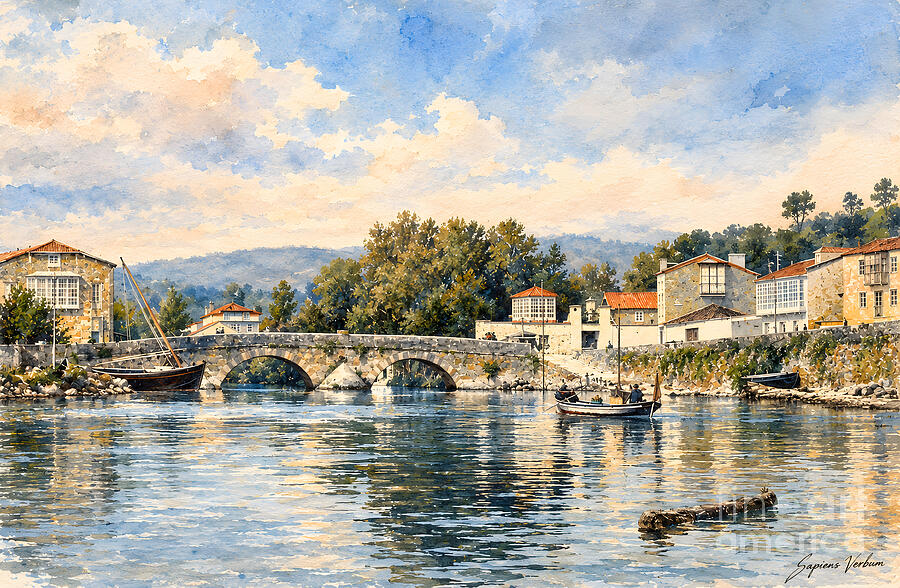
The tide is in and the water lies almost still. A small boat with its crew drifts across the river below a low stone bridge, another boat waits by the bank with its mast leaning against the sky, and stone houses with red roofs and glazed balconies look down on the water from among the trees. This is the bridge of Xubia (Jubia in Spanish), where the river Xubia meets the Ría de Ferrol, as it appeared on a postcard printed in 1906. This first image is an interpretation, painted in loose watercolour washes; the old postcard it grew from appears further down.
🖼️ Get this photo as a print →
Original photograph: Photographer not named, 1906 (postcard published by Papelería de El Correo Gallego, printed in Berlin by Julius Nagelschmidt; restored, also available as a print)
Interpretation: Sapiens Verbum
Subject: The stone bridge of Xubia seen from the estuary, with two boats, one of them carrying a group of men
Location: Ponte de Xubia, between Neda and Narón, A Coruña, Galicia, Spain
Medium: 1906 colour photogravure postcard, restored, and a watercolour interpretation of the same view
Series: Ferrolterra
The watercolour keeps the postcard’s low viewpoint, almost at the level of the water, and lets the light do the rest. The sky opens into tall clouds washed in blue, cream and apricot, and their colours fall back into the river as long broken reflections. The bridge becomes a band of warm grey stone, the trees behind it a dense mass of olive and dark green, and the houses on the right step up the slope in ochre walls and red roofs. The men in the boat are reduced to a few dark strokes, and a stray log floats in the foreground. It is the same quiet corner of the ría, seen on a soft summer afternoon.
A bridge of the Andrade lords
A bridge has crossed the Xubia at this point since the Middle Ages. According to the tourism office of Narón, the first one was built around 1370 by Fernán Pérez de Andrade, the powerful lord who also built the great bridge at Pontedeume, as part of a coastal road; travellers paid a toll to cross. It is still known as the Ponte dos Andrade. That medieval bridge, with three stone arches, was later replaced by a wooden one, and the stone bridge that appears on the postcard was built in the nineteenth century: an inscription on one of its parapets gives the date 1831. According to Narón, its last remodelling came after the Spanish Civil War, and metal beams were added at some point to widen it with pavements, so the bridge you see today is not quite the one in the photograph.
For centuries this was a key crossing. The road over the bridge joined Ferrol and its district to the rest of Spain along the old road to Castile, and here the river Xubia ends and the Ría de Ferrol begins. The bridge today joins two municipalities, Narón on one bank and Neda on the other.
Mills, copper and coins
The quiet scene hides one of the most industrious corners of eighteenth- and nineteenth-century Galicia. Beside the bridge stands the mill of Xubia, a flour mill built in 1775 that belonged, with the tide mill of As Aceas a little further along the shore, to a network of industrial mills run by French entrepreneurs. Both were declared a Royal Factory by Carlos IV in 1798, and in 1858 it was described as the largest mill of its kind in the country, grinding wheat brought by ship from the Baltic and from America. In later years its water power also drove a paper mill, a textile factory and a copper-rolling works.
Opposite the mill, on the Neda bank, stood the Real Fábrica de Xubia. It was founded in 1790 as a copper works to supply the naval shipyards of Ferrol, and began producing copper sheet in 1803. During the war against Napoleon, with the mint at Segovia in French hands, it became a royal mint in 1811 and struck copper coins in the name of Fernando VII from 1812, on and off, until 1868. In 1873 the site was sold at auction and converted into a linen mill.
The photograph behind it
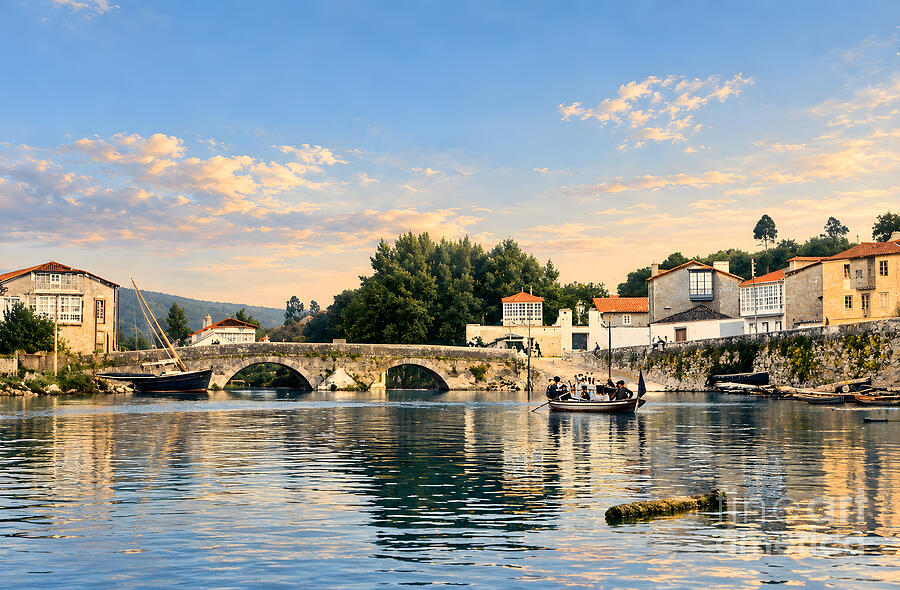
The source is a postcard titled Ferrol. Jubia. El puente, number 7 in series III (no. 907), published in 1906 by the stationery shop of El Correo Gallego, the newspaper then published in Ferrol, and printed in Berlin by Julius Nagelschmidt. It is a colour photogravure of 14 by 9 centimetres with an undivided back, reserved for the address alone, printed with the words “Unión Postal Universal”. This copy was written on and sent to Madrid; its postmark survives but the stamp has been torn off. The photographer is not named. The card is preserved by the Biblioteca de Galicia (shelfmark POS 501) and catalogued in its digital library, Galiciana, as a public-domain work, described as a view of the Xubia bridge, today in the municipality of Neda, from the ría, with two boats, one of them carrying men.
Below is that photograph, restored so that the scene reads clearly again: the same stone arches and riverside houses, the boat full of men in the middle of the river and the moored boat with its slanting mast, all bathed in a warm late-afternoon light. The interpretation above keeps the postcard’s bridge, boats and houses, and changes the colour, the light and the touch.
Visiting the Xubia bridge today
The bridge stands at the head of the ría, a short drive from Ferrol, and it is also on the Camino Inglés: pilgrims setting out from Ferrol cross the Xubia here to enter Neda, whose pilgrims’ hostel, about 12 km from Ferrol, was the first public one on the route. Stop on the bridge to look at the mill of Xubia, now restored by the council of Narón, then follow Narón’s Ruta dos Muíños (mills route) to the tide mill of As Aceas and its great dam. Come at high tide, find a spot on the bank downstream and you can still line up the arches and the houses on the hill with the old card.
See more of the Ría in motion
Our travel channel has driven the roads around the Ría de Ferrol:
For another postcard from the same Ferrol publisher, see Ferrol’s central market in 1919. The whole ría, from Ferrol to the head of the estuary, appears in Ferrol’s ría at sunset from Monte Ancos, and the bridge that Fernán Pérez de Andrade built at Pontedeume in Pontedeume’s medieval stone bridge by night.
Bring the calm of the Xubia estuary in 1906 to your wall. Both versions of this scene, the watercolour interpretation and the restored original photograph, are available as museum-quality prints, canvas or posters, and both can also be licensed for your own project.
 Buy the Interpretation
Buy the Photograph
Buy the Interpretation
Buy the PhotographLicense the Interpretation License the Photograph
Printed and shipped by Fine Art America · 30-day money-back guarantee
See the Xubia bridge on Google Maps
Part of the Ferrolterra series.
Comments
Post a Comment