The Meeting on the Turret Stairs: A Vintage Art Nouveau Poster from Frederic William Burton's Watercolour
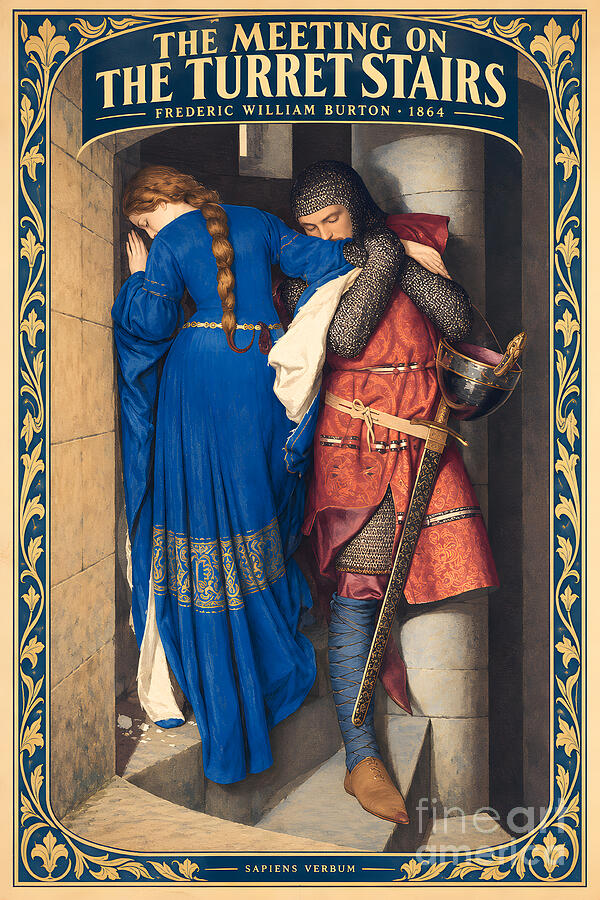
A young woman in a blue gown turns her face to the cold stone of a tower stairwell. Behind her a knight in mail and a red surcoat bends to press his lips to her arm, his helmet hanging from his hand and his sword still in its scabbard. Neither of them looks at the other, and that is the whole story. This poster takes Frederic William Burton’s Victorian watercolour of Hellelil and Hildebrand and frames it the way an Art Nouveau gallery sheet would: a deep blue border of gold lilies and scrolls, an arched title panel, and cream lettering in large Roman capitals.
🖼️ Get this poster as a print →
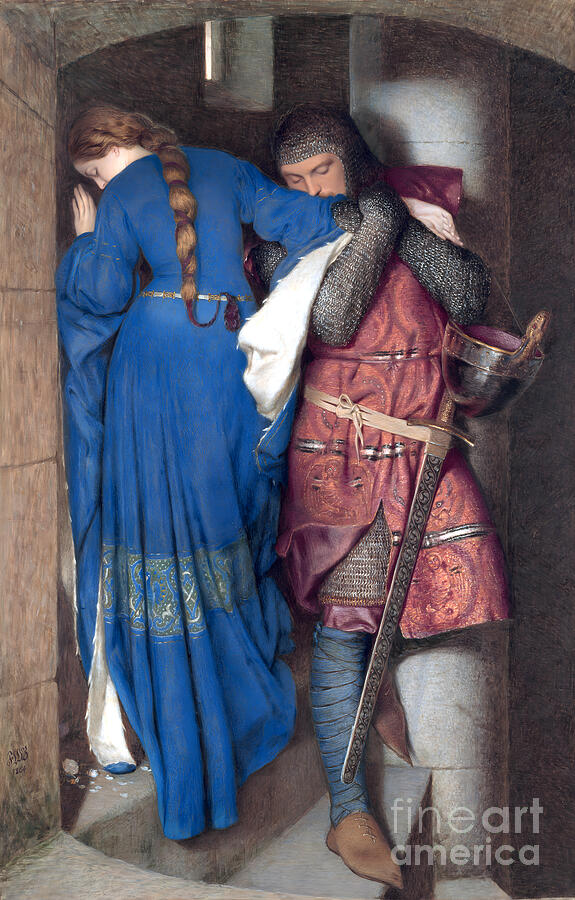
A painting, held as a poster. Most of the posters on this blog start from our own photographs. This one starts from a Victorian watercolour, the picture voted Ireland’s favourite painting in 2012. The source is Frederic William Burton’s Hellelil and Hildebrand, the Meeting on the Turret Stairs, painted in London in 1864 and now in the National Gallery of Ireland in Dublin. The poster is the interpretation. It is not the painting, and it does not pretend to be.
Source painting: Hellelil and Hildebrand, the Meeting on the Turret Stairs, by Frederic William Burton (1816–1900)
Date: 1864
Medium: Watercolour and gouache on paper, 95.5 × 60.8 cm
Whereabouts: National Gallery of Ireland, Dublin (NGI.2358), bequeathed by Margaret Stokes, 1900
Story: A medieval Danish ballad, translated into English by Whitley Stokes in 1855
Subject: The last meeting of Hellelil, a king’s daughter, and Hildebrand, her guard
Poster: Sapiens Verbum
Work: Vintage Art Nouveau poster
A farewell before the swords
The story comes from a medieval Danish ballad that Burton’s friend, the Celtic scholar Whitley Stokes, translated into English in 1855. Hellelil, a king’s daughter, falls in love with Hildebrand, the young prince set to guard her. Her father disapproves and sends her seven brothers to kill him. Hildebrand asks her one thing: whatever happens, never to call out his name. When she sees him fall to her brothers’ swords, she cries it aloud, and she pays for it. Burton painted none of that. He chose the moment just before, the last meeting of the two lovers on a narrow stair, when the ending is already certain and nobody has said so.
We tell the longer story of the painting, of Burton and of the Stokes family circle in our essay The Meeting on the Turret Stairs by Frederic William Burton on Sapiens Verbum.
The vintage Art Nouveau poster
The painting stays as the bones. The stairwell curves upward in pale stone, Hellelil leans into the wall with her long braid down her back, and Hildebrand bends behind her, one arm around her shoulders, his helmet hanging loose from his fingers. What the poster adds is what a sheet for a wall needed and a gallery watercolour did not: a frame, period lettering, and a cleaner, brighter palette of ultramarine, red, gold and warm stone.
The lettering is THE MEETING ON THE TURRET STAIRS in large cream capitals on a dark blue arched panel, with a thin line that reads FREDERIC WILLIAM BURTON · 1864. Gold fleurs-de-lis and scrolling stems run all the way around the border, and a small SAPIENS VERBUM signs the foot. Her blue gown echoes the blue of the frame, so the border reads as part of the picture rather than a box around it. The lovers are still Burton’s lovers. The border is the only fiction.
Why it works as a poster
A good poster has to read from across a room, and this scene does. There are two figures, one blue and one red, pressed together in a tall narrow space, and the format of the stair already is the format of a poster. You understand the picture before you read a word of it. And the subject needs no translation: anyone who has said goodbye without knowing if it was the last time knows what is happening on that stair. It is a love story told without a kiss on the lips or a single line of dialogue.
The painting behind the poster
Get the original painting as a print →
Burton never painted in oils, yet by layering watercolour and gouache with a miniaturist’s patience he reached a depth of colour close to oil. That same gouache is what makes the original so fragile. It fades under light, so the National Gallery of Ireland keeps the watercolour in a special cabinet and shows it in Room 20 for only two hours a week, on Thursdays from 11.30am to 12.30pm and on Sundays from 2pm to 3pm. A buyer of the poster is not getting the painting. They are getting the poster made from it, designed and interpreted by Sapiens Verbum, and one you can look at every day.
The series continues with other posters: Argos and Odysseus, after Briton Riviere, and the travel posters Arcos de la Frontera, Ferrol and the Juan Sebastián Elcano, Prague, Old Town Square and the Týn Church and Vienna, The Staatsoper and the Ringstrasse.
Bring Hellelil and Hildebrand’s last meeting to your wall as a vintage Art Nouveau poster from the Sapiens Verbum print shop.
 Choose your size and frame →
License this poster
Choose your size and frame →
License this posterSee the original painting →
Printed and shipped by Fine Art America · 30-day money-back guarantee
💬 Over to you: The painting shows itself two hours a week. The poster stays on your wall. Which one would you hang? Tell us in the comments.
More posters in the Vintage Art Poster series, and the full story in our essay on The Meeting on the Turret Stairs by Frederic William Burton.
Sources
National Gallery of Ireland — Hellelil and Hildebrand, the Meeting on the Turret Stairs (NGI.2358)
National Gallery of Ireland — Visitor Guide: viewing times
BBC Culture — The tragic romance hidden in a 19th-Century painting
Wikipedia — Frederic William Burton
Sapiens Verbum — The Meeting on the Turret Stairs by Frederic William Burton
Sapiens Verbum — The Meeting on the Turret Stairs vintage Art Nouveau poster
▶️ Watch on YouTube: Frederic William Burton: The Tragic Story Hidden in Ireland’s Favorite Painting on @SapiensVerbum
Comments
Post a Comment