Ferrol, Juan Sebastian Elcano: Vintage Travel Poster from Our Own Photograph
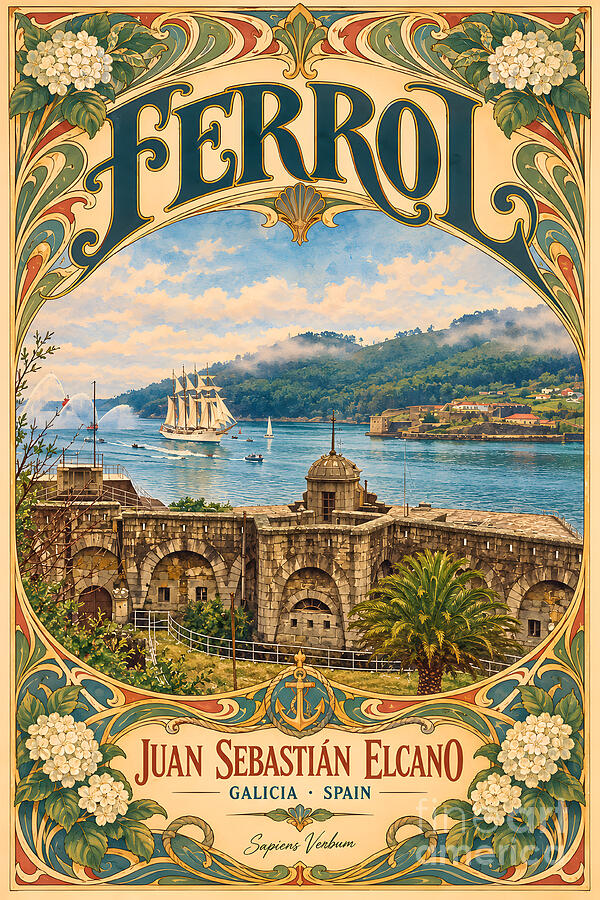
FERROL, in tall deep-teal capitals edged in gold, fills the top of the sheet, with a gilded scallop shell tucked beneath the letters. Through the arch below, the Spanish Navy’s training ship sails into the ría under all her canvas, four masts of white sail against misty green hills, while fireboats throw arcs of water into the air and launches and a small white yacht keep her company. Across the water a low fortress and a scatter of houses sit on the far shore, and in the foreground the old stone ramparts of a coastal castle, with their arched vaults, a domed lookout and a palm tree, hold the whole scene like a balcony. At the foot of the frame, beneath an anchor, comes the ship’s name, Juan Sebastián Elcano, and then Galicia · Spain. This is the sixth poster in our series of vintage travel posters, and the second made from a photograph of our own, taken by Sapiens Verbum from the walls of the Castillo de La Palma.
🖼️ Get this poster as a print →
Original photograph: Juan Sebastian Elcano Arrival to the Port of Ferrol, by Sapiens Verbum
Interpretation: Sapiens Verbum
Subject: The training ship Juan Sebastián de Elcano under sail in the Ría de Ferrol, seen from the ramparts of the Castillo de La Palma, with the Castillo de San Felipe across the water
Location: Castillo de La Palma, Mugardos, Ría de Ferrol, A Coruña, Galicia, Spain
Medium: Art Nouveau travel-poster interpretation in a watercolour and lithographic style
Lettering: FERROL · Juan Sebastián Elcano · Galicia · Spain · Sapiens Verbum
Series: Vintage Travel Posters from Old Photographs
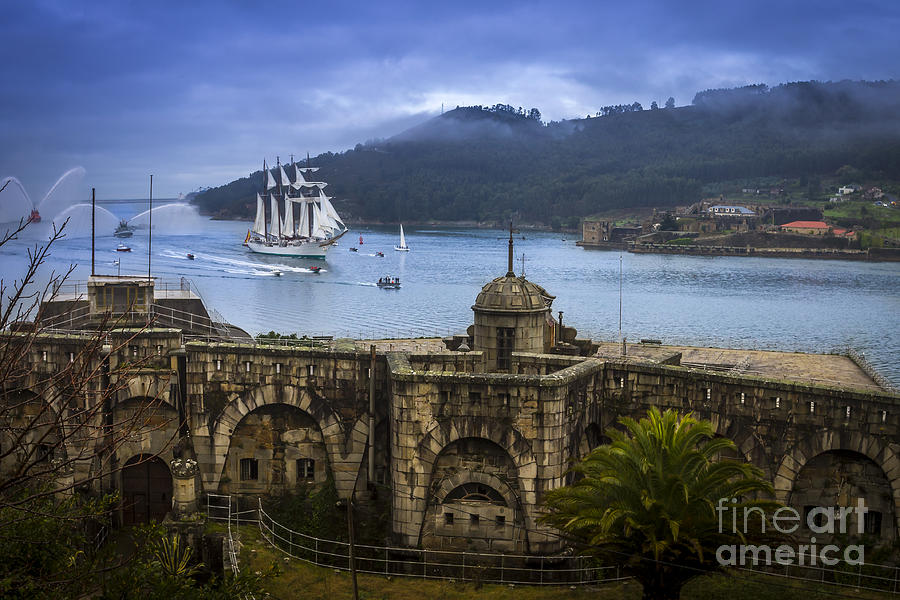
The poster follows the photograph closely: the ship in the same place in the channel, the fireboats on the left, the far shore with its fort and houses, and in front the long line of vaulted casemates and the little domed turret of La Palma. What changes is the weather. The camera saw a soft, overcast Galician sky in lilac and grey; the poster turns it into a summer afternoon, with cream and apricot clouds over a clear blue, and lets the mist lie only on the tops of the hills. The ship is gently enlarged, the water is brighter, and the green of the woods becomes the green of the frame. That frame is pure Art Nouveau: whiplash curves in teal, sage, terracotta and gold, a cluster of white hydrangeas in each corner, a palmette at the top, and at the foot an anchor hanging from a looped rope, the one ornament that tells you this is a sailor’s town. The scallop shell under the name belongs here too. Ferrol is where most walkers of the English Way to Santiago set out, and the shell has been the pilgrim’s badge for centuries.
A ship named for the first voyage around the world
The Juan Sebastián de Elcano is the training ship of the Spanish Navy, a four-masted topsail schooner (in Spanish, a bergantín-goleta) built by the Echevarrieta y Larrinaga yard in Cádiz. She was laid down in 1925, launched on 5 March 1927 and commissioned in August 1928, and on her first training cruise she sailed right around the world. She is 113 metres long including the bowsprit and carries 20 sails with a total area of 3,151 square metres. Her four masts are named Blanca, Almansa, Asturias and Nautilus, after four earlier training ships of the Navy (Juan Sebastián de Elcano (A-71)).
Her name honours the navigator who took command of Magellan’s expedition after Magellan’s death and brought it home in 1522, completing the first voyage around the world. The ship carries the coat of arms granted to Elcano’s family by the Emperor Charles V, crowned with a globe and the Latin motto Primus circumdedisti me, “You were the first to sail around me”. Generations of Spanish naval officers have trained aboard her, among them King Juan Carlos I in 1958, King Felipe VI in 1987 and Princess Leonor in 2025. Twenty-five years after she was built, the same plans were used for the Chilean Navy’s training ship Esmeralda.
Between the castles
The entrance to the Ría de Ferrol is a long, narrow channel, and for centuries it was the city’s best defence. Work on the Castillo de San Felipe, on the northern shore, began in 1557 under Philip II, from whom it takes its name, together with two forts on the southern shore, La Palma and San Martín. In time of war a heavy chain could be stretched across the water between San Martín and San Felipe to stop enemy ships from entering. Between 1731 and 1755 the engineer Francisco Montaigú remodelled San Felipe on the principles of Vauban, with a double line of guns facing the sea (Castillo de San Felipe, Ferrol).
The fortifications had their great test on 25 August 1800, when a British expedition under Rear Admiral John Borlase Warren tried to take Ferrol and destroy its shipyards. In the fighting known as the Battle of Brión, three assaults on San Felipe were driven back with the help of the guns of La Palma and of gunboats in the ría, and the British re-embarked; Napoleon is said to have toasted “the brave men of Ferrol”. The castle in the foreground of the poster, the balcony from which we look, is La Palma, in the municipality of Mugardos, whose origins go back to the end of the sixteenth century and whose present buildings date mostly from the nineteenth and twentieth (Castillo de La Palma). The fort on the far shore, below the hills, is San Felipe. Both castles are protected as Bienes de Interés Cultural, and San Felipe has belonged to the city of Ferrol since 2000.
A naval city and its ship
Ferrol owes its shape to the Navy. Its great Arsenal was planned in 1747, approved in 1750 and revised under the supervision of the naval engineer Jorge Juan, as a great naval base and shipyard, with a basin designed to hold seventy ships of the line. Today the yards belong to Navantia and still build warships (Arsenal de Ferrol). So when the Elcano comes in, the whole town turns out.
On 15 February 2013 she sailed into the ría under canvas, passed between the castles of La Palma and San Felipe on the high tide and berthed at the Arsenal, her first call at Ferrol since 1999. She was bringing home 38 trainee sailors of the Navy’s school at A Graña, on the ría, at the end of a 33-day training voyage to Casablanca and Madeira, and the next day she left again, under full sail, watched by thousands of people on both shores (El País, 15 February 2013). Her next call came twelve years later: on 8 July 2025 she entered the ría again under sail, between the same two castles, with Princess Leonor aboard as a midshipman, and the next morning she tied up at the Curuxeiras quay, the first time she had berthed in Ferrol since 2013 (COPE, 9 July 2025).
The photograph behind it
The source is a photograph by Sapiens Verbum, taken from the walls of the Castillo de La Palma during the ship’s visit of February 2013. The Elcano glides up the channel with her sails set, fireboats on the left send up white plumes of water in salute, and a crowd of small craft follows in her wake. Across the ría, San Felipe and the houses of the northern shore sit below hills wrapped in low cloud, and in the foreground the vaulted casemates, the domed turret and the palm of La Palma are exactly where the poster puts them. We published the photograph, with a second version that has a generated sunset sky, in Juan Sebastian Elcano Arrival to the Port of Ferrol. The poster keeps the ship, the castle, the fireboats and the far shore, and adds the frame, the lettering and a summer sky.
Get the original photograph as a print →
Seeing the view today
The Castillo de La Palma stands on the southern shore of the ría, in the municipality of Mugardos, at the narrowest part of the channel. From its walls you have the poster’s view in front of you: the channel, the Castillo de San Felipe on the far shore and the hills of Brión behind it. Across the water, San Felipe is open to visitors as a cultural site, and from its ramparts you see the same scene in reverse, with La Palma below the hills of Mugardos. Every ship bound for the Arsenal and the shipyards passes between the two, and on the rare days when the Elcano comes in, both shores fill with people. Back in the city, the Museo Naval and Exponav, the museum of naval construction, keep the story of the naval town that the castles were built to protect.
For more of Ferrol, see the Elcano arriving at Ferrol, the photograph behind this poster, and the same ship in a very different light in Juan Sebastián de Elcano, Cadiz Departure at Sunset (1992). From the city’s past come the Naval Hospital in 1902 and the Central Market in 1919, and from the ría today the estuary at dusk, with its shipyards and bridge, the ría at sunset from Monte Ancos and the harbour of Mugardos, on the shore across from San Felipe. More sail is in the Tall Ships series. The poster series began with Fene, Paisaje de Maniños, made from a 1932 postcard of this same ría, and continued with Venice, The Grand Canal and Santa Maria della Salute, Pontedeume, The Eume River and Bridge, the first poster made from a photograph of our own, Paris, The Eiffel Tower and the Trocadéro and Amalfi, From the Cappuccini.
Bring the Ría de Ferrol to your wall in the style of a golden-age travel poster. This Art Nouveau poster of the Juan Sebastián de Elcano sailing in between the castles is available as a museum-quality print, canvas or poster, and it can also be licensed for your own project. The original photograph is available as a print too.
 Buy Fine Art Print
License Photograph
Buy Fine Art Print
License PhotographBuy the Original Photograph
Browse the full collection →
Printed and shipped by Fine Art America · 30-day money-back guarantee
See the Castillo de La Palma on Google Maps
Part of the Vintage Travel Poster series.
Comments
Post a Comment