Maniños, Fene, 1932: Photograph and Interpretation
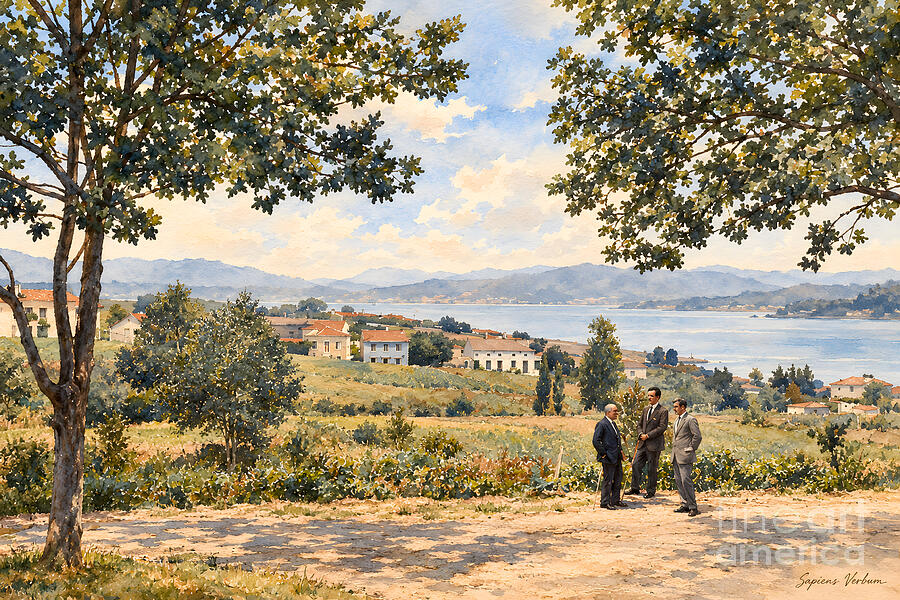
Two tall trees frame the view like a pair of curtains. Between them a dusty road crosses the foreground, rough fields and hedges fall away to a scatter of houses on the slope, and beyond the last roofs the Ría de Ferrol opens out, calm and silver under a line of distant hills. In the middle of the road three men in suits have stopped to pose, one of them leaning on a walking stick. This is Maniños, a parish of Fene on the southern shore of the ría, as it appeared on a postcard of the early 1930s. This first image is an interpretation, painted in loose watercolour washes; the old postcard it grew from is described further down.
🖼️ Get this photo as a print →
Original photograph: Photographer not named, 1932 (postcard printed by Heliotipia Artística Española, Madrid)
Interpretation: Sapiens Verbum
Subject: A general view of the parish of Maniños with the ría in the background and three men posing on the road
Location: Maniños, Fene, A Coruña, Galicia, Spain, on the southern shore of the Ría de Ferrol
Medium: Watercolour interpretation of a public-domain postcard photograph
Series: Ferrolterra
The watercolour keeps the postcard’s frame exactly: the slender trunk on the left, the heavy branch reaching in from the right, the three figures and the houses on the hill. What it adds is a summer afternoon. Sunlight comes through the leaves in flecks of lime and olive, their shadows fall across the pale road, and the fields turn gold and green, dotted with dark cypresses. The houses become white and cream walls under terracotta roofs, the ría takes on a clear silver-blue, and the hills behind fade into soft lilac beneath drifting clouds. The men keep their poses: one older and grey-haired in a dark suit with his stick, one in brown, one in grey, as if the photographer had only just asked them to stand still.
A parish on the ría
Maniños, officially the parish of Divino Salvador de Maniños, is one of the eight parishes of Fene. It is small, about two and a half square kilometres, bounded to the north by the Ría de Ferrol and made up of hamlets such as Ribeira, Garita, Cruceiro and Piñeiro. According to the place-name scholar cited by Fene’s tourism office, its name comes from a Latin word meaning barren or uncultivated land, which the green fields on this card seem to contradict.
Its history goes back a very long way. The oldest traces of human life found anywhere in the municipality of Fene, stone tools of the Middle Palaeolithic, came from the shore of Maniños. Much later, under the reforms of the Cortes of Cádiz, Maniños even became a municipality of its own in 1812, alongside Fene and Barallobre; the three were dissolved in 1823, and when Fene was re-established as a municipality in 1835 it took in the parishes of the other two.
Tanneries, boats and returning emigrants
A description written in 1906, a generation before this postcard, and quoted by Fene’s tourism office, describes Maniños as more distinctive and flourishing than its neighbours. It had several tanneries, by then in decline, and fishing and trade with trincados, boats of 30 to 50 tonnes, which were also disappearing. Its people had not given up farming, and emigrants who came home with money were building houses and walled plots with vines and fruit trees, selling their produce in Ferrol across the water. The parish then had 1,217 inhabitants.
The shore of Maniños has always lived from the sea. Fene’s tourism office recalls the old boatyards known as “Adriano”, linked to Antonio Fernández, a Galician emigrant to Cuba, and the shellfishing that continues today, above all for clams. Emigration to the Americas marked the whole municipality, which is still dotted with the houses built by returning indianos.
The shipyards next door
A few years after this postcard, the shore of Fene changed for good. In 1941 a small wooden boatyard a little further along the shore, in the parish of Perlío, became Astano, Astilleros y Talleres del Noroeste, founded by the naval engineer José María González-Llanos y Caruncho, whose face survives in an anonymous oil portrait and whose life is told in a biography by his grandson, Ramón María Tenreiro. It began with small wooden fishing boats, and from 1963 grew into one of the world’s great builders of giant tankers, employing thousands of workers. Between 1967 and 1983 it built 38 tankers, among them the supertanker Arteaga, at the time the largest ship ever launched from a slipway. After the shipbuilding crisis of the 1980s the yard turned to offshore oil platforms, passed into the state group Izar and now belongs to Navantia. Today the yard at Perlío builds giant steel foundations for offshore wind farms, which can be seen sailing out of the ría on heavy-lift ships.
The photograph behind it
The source is a postcard captioned Ferrol. Paisaje de Maniños, a reminder that a view of a country parish across the water was sold under the name of the city everyone knew. It is a photogravure of 9 by 14 centimetres, printed in Madrid by Heliotipia Artística Española, whose monogram appears on the back. Neither the publisher nor the photographer is named. The card was never posted, and an ink stamp on the back, dated 12 June 1932, gives the date under which the library catalogues it. It is preserved by the Biblioteca de Galicia (shelfmark POS 1378) and can be seen in its digital library, Galiciana, where it is catalogued as a public-domain work, described as a general view of the parish of Maniños with the ría in the background and a group of men posing. The interpretation above keeps the postcard’s trees, road, figures and view, and changes the colour, the light and the touch.
Visiting Maniños today
Maniños is a short drive from Ferrol around the head of the ría. Head down to the Ribeira de Maniños, a pleasant shore for a walk, and to the Praia da Garita, a small cove of fine white sand with a picnic area and a viewpoint over the Ría de Ferrol. Up the hill, the parish church of San Salvador, in a popular Baroque style, has side chapels founded in 1669 and 1760 and a main altarpiece carved in 1857 by Manuel Fernández of Ferrol. The Camino Inglés does not pass through Maniños itself, but it crosses the municipality of Fene, through Conces, the town centre and Barallobre, on its way from Neda to Cabanas and Pontedeume. The parish holds its feasts for O Carme and for San Salvador on 5 August, and the Romaría do Pote on the last Sunday of August.
See more of the Ría in motion
Our travel channel has driven the roads around the rías of Ferrol and Ares:
For other early postcards from around the ría, see Ferrol’s new naval hospital in 1902, the Xubia bridge in 1906 and Ferrol’s central market in 1919. The shipyards of the ría appear in the Ferrol estuary at dusk, and Maniños’ neighbour on the same shore in the Mugardos harbour panorama. From Sapiens Verbum Art, meet the founder of Astano in the portrait of José María González-Llanos y Caruncho, and from our books blog, the engineer who rebuilt Ferrol’s shipyards.
Bring a quiet summer day on the Ría de Ferrol to your wall. This watercolour interpretation is available as a museum-quality print, canvas or poster, and it can also be licensed for your own project.
 Buy Fine Art Print
License Photograph
Buy Fine Art Print
License PhotographPrinted and shipped by Fine Art America · 30-day money-back guarantee
See Maniños on Google Maps
Part of the Ferrolterra series.
Comments
Post a Comment