The Bridge at Pontedeume, c. 1900-1930: Photograph and Interpretation
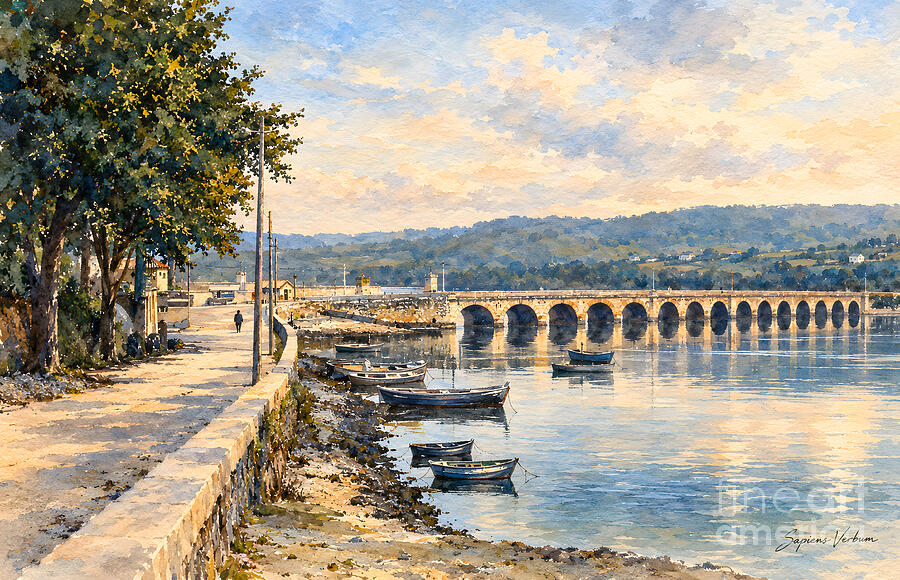
A tree-lined road runs along the shore behind a low stone wall. A lone figure walks in the shade, telegraph poles march away along the road, and below the wall the tide has drawn back to leave rowing boats resting on the mud and in the shallows. Beyond them, a long line of round stone arches strides across the estuary towards the hills. This is the bridge of Pontedeume over the river Eume as it appeared on a postcard printed sometime between 1900 and 1930, when the bridge in the picture was still a fairly new one. This first image is an interpretation, painted in loose watercolour washes; the old postcard it grew from is described further down.
🖼️ Get this photo as a print →
Original photograph: Photographer not named, c. 1900–1930 (postcard no. 14, Fototipia Thomas, Barcelona)
Interpretation: Sapiens Verbum
Subject: The stone bridge over the Eume seen from the shore road, with rowing boats at low tide
Location: Ponte do Eume, between Pontedeume and Cabanas, A Coruña, Galicia, Spain
Medium: Watercolour interpretation of a public-domain postcard photograph
Series: Pontedeume
The watercolour keeps the postcard’s composition almost line for line: the dark mass of trees on the left, the wall curving away along the road, the boats scattered across the foreshore and the bridge closing the view. What it adds is light and colour. The sky opens into soft clouds of cream, apricot and blue, the stone of the arches turns to a warm gold, and the calm water picks up every tone and breaks it into long, glinting reflections. The mud and weed of the foreshore are laid in browns and olive greens, and the far hills fade into blue-green haze. The old card was printed in a single cold tone; here the same quiet moment is seen at the end of a summer day.
A new bridge on an old crossing
There has been a bridge at Pontedeume for as long as there has been a town; the name simply means “bridge on the Eume”. The great medieval bridge of the Andrade lords, with its towers, chapel and pilgrims’ hospital, is the subject of our post on Pontedeume’s medieval stone bridge by night. What the camera recorded on this postcard, though, was something much younger. By the middle of the nineteenth century the old bridge was worn out, and in 1856 a new road to A Coruña was planned that included replacing it. According to Pontedeume Turismo, a temporary wooden crossing was opened in 1862, the last remains of the medieval bridge were demolished in 1863, and the new stone bridge came into service in 1870.
It did not last long in that form. On 26 December 1874 the Eume in flood swept away its first three arches, and traffic crossed on a provisional timber section from 1876 until 1881, when new stone arches came into use; the work was finished by the end of the 1880s. The town council gives the dates of this remodelling as 1884 to 1888 and describes the result as the bridge of fifteen arches that still stands. So when this postcard was printed, the round arches in the picture were at most a few decades old, built on the line of a crossing that was already centuries old.
The bear, the boar and the legend of O Boo
The medieval bridge was built for Fernán Pérez de Andrade, known as O Boo (“the Good”), who received the lordship of Pontedeume from Henry II of Castile in 1371. Legend credits him with building seven churches, seven monasteries, seven hospitals and seven bridges. Whether or not the count is exact, his building programme was enormous, and this bridge was one of its greatest works.
Between its second and third arches, set on pedestals in the hollows of the cutwaters, stood two stone animals: a bear and a boar, the emblems of the Andrade family. The boar carries an inscription in medieval Galician on its back recording that the bridge was begun in April of the year 1380 and finished in six years. When the Benedictine scholar Martín Sarmiento saw the figures in 1745, he noted two local explanations for them: that the men who built the bridge had names that alluded to the two animals, or that a count, out hunting, had killed a boar and a fearsome bear and had them set up in memory. The figures were taken from the bridge in 1843. For many years they stood on a roundabout at the entrance to the town, and in 2010 they were moved, for their protection, to the gardens of the Casa da Cultura in the old Augustinian convent, where they can be seen today. The bear and the boar still flank a silver bridge on Pontedeume’s coat of arms.
A working estuary
The boats on the card are a reminder that the Eume was a working river. When Alfonso X founded the town in 1270, its charter granted it a monthly market and free fishing, and fishing and the waterfront shaped Pontedeume for centuries afterwards. The bridge itself carried the main coastal road from A Coruña and Betanzos to Ferrol, and it remained the principal route along the coast until the AP-9 motorway between Guísamo and Ferrol opened in 2003. Today the N-651 still runs across it.
The decades when this card was printed brought big changes to the estuary. Downstream, an iron railway bridge was built across the mouth of the Eume around 1910 for the Betanzos to Ferrol line, which opened officially on 5 May 1913, and in 1911 a new avenue was opened in the town to reach the station. Later in the century the town grew out over the water: the draining of the marshes began in the late 1940s, and the present seafront promenade was opened in 1996.
The photograph behind it
The source is postcard number 14, captioned Puentedeume. El Puente, in an album published by Fototipia Thomas of Barcelona, Recuerdo de Puentedeume y sus alrededores. Album n.º 2. It is a booklet of ten unused postcards, 9 by 16 centimetres, numbered 11387 to 11396 in the Thomas collection and carrying the imprint “Edición M. López”. As with most of the Thomas view albums, the photographer is not named. The original is printed in a single blue-grey tone, with the bridge reflected in still water and the boats lying on the foreshore at low tide. The album is preserved by the Biblioteca de Galicia and can be seen in its digital library, Galiciana (shelfmark POS 1485), where it is catalogued as a public-domain work and dated broadly to between 1900 and 1930. The same album also gave us Playa de la Magdalena. The interpretation above keeps the postcard’s road, boats and bridge, and changes the colour, the light and the touch.
Visiting the bridge today
The bridge can be crossed on foot, and it is part of the Camino Inglés, the English Way to Santiago, which crosses the Eume here. Walk out along it for the long view up and down the estuary, with the blue iron railway bridge downstream and the wooded valley that leads up towards the Fragas do Eume upriver. Back in town, the bear and the boar that once guarded the medieval bridge wait in the garden of the old Augustinian convent, now the Casa da Cultura. Come at low tide, when the boats settle on the mud along the shore, and you can still find something very close to the postcard’s view of the arches reaching across the water.
See more of the Ría in motion
Our travel channel has filmed the roads around Pontedeume:
For the same bridge lit up at night, see Pontedeume’s medieval stone bridge by night, and for another scene from early twentieth-century Pontedeume, the Tree Festival in Praza do Conde, c. 1914. Daily life on the waterfront today appears in fishermen repairing nets in Pontedeume, and the whole town from the hill opposite in Pontedeume from Cabria, Nogueirosa.
Bring the calm of the Eume estuary a century ago to your wall. This watercolour interpretation is available as a museum-quality print, canvas or poster, and it can also be licensed for your own project.
 Buy Fine Art Print
License Photograph
Buy Fine Art Print
License PhotographPrinted and shipped by Fine Art America · 30-day money-back guarantee
See the bridge of Pontedeume on Google Maps
Part of the Pontedeume series.
Comments
Post a Comment