Venice, The Grand Canal and Santa Maria della Salute: Vintage Travel Poster from an 1890s Photochrom
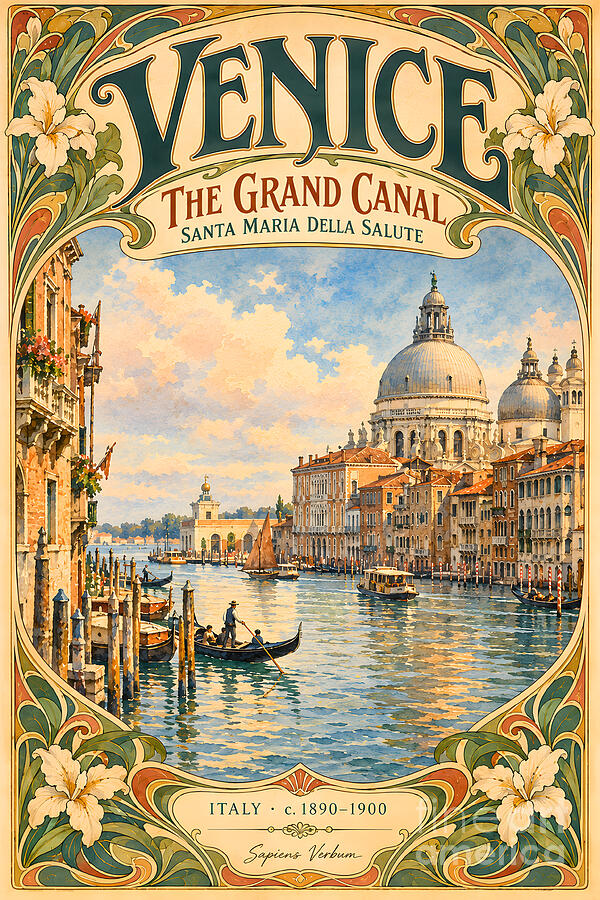
VENICE, in tall bottle-green capitals, fills the top of the sheet, and below it, on a cream ribbon, come the words The Grand Canal and Santa Maria della Salute. Through an arch of leaves and white lilies the canal opens out in late-afternoon light. On the right the great domes of the Salute rise above a row of palaces, their windows catching the sun; on the left a gondolier steers past a cluster of striped mooring poles, a small steamer crosses the water, a boat with an ochre sail heads out, and far away, at the end of the canal, stands the white tower of the Dogana. At the foot of the frame a panel reads Italy · c. 1890–1900. This is the second poster in our series of vintage travel posters made from old photographs, and its source is a colour print sold to travellers in the 1890s.
🖼️ Get this poster as a print →
Original photograph: Photochrom print, between ca. 1890 and ca. 1900 (print no. 6994, marked “P.Z.”, Photochrom / Photoglob Zürich; title from the Detroit Publishing Co. catalogue)
Interpretation: Sapiens Verbum
Subject: The Grand Canal with the basilica of Santa Maria della Salute, a gondola and a moored steamboat
Location: Santa Maria della Salute, Dorsoduro, Venice, Italy
Medium: Art Nouveau travel-poster interpretation of a public-domain photochrom
Lettering: VENICE · The Grand Canal · Santa Maria della Salute · Italy · c. 1890–1900 · Sapiens Verbum
Series: Vintage Travel Posters from Old Photographs
The poster rearranges the old view rather than copying it. In the photochrom the Salute and the customs house stand on the left, a single gondola with its small canopied cabin crosses the open water in the middle, and a small white steamboat is moored to a post near the church. The poster turns the scene around, brings the domes to the right, adds the palaces and the mooring poles of a Venetian waterfront in the foreground and sets the Dogana far off at the end of the canal. The frame is pure Art Nouveau: whiplash curves in sage, rust and gold, a shell-shaped fan at the top and the bottom, and in each corner a spray of white lilies. The choice of flower is not only decorative. The white lily is the traditional symbol of the purity of the Virgin Mary in Christian art (Madonna lily), and the church at the centre of the picture is hers.
A church for the end of a plague
In the summer of 1630 the plague reached Venice, and by 1631 it had killed nearly a third of the population, some 46,000 people in the city alone. Prayers and processions had failed to stop it, and on 22 October 1630 the Venetian Senate decreed that a new church would be built, dedicated not to a plague saint but to the Virgin Mary, as Our Lady of Health (Santa Maria della Salute). The site chosen was the tip of Dorsoduro beside the sea customs house, the Dogana da Mar, where the Grand Canal meets the basin of San Marco, so that the church would be seen by everyone arriving by water.
A competition followed, and the Senate chose the design of a young architect, Baldassare Longhena, who described his plan as a round church “in the shape of a crown” for the Virgin. Building began in 1631 on a platform said to rest on a million wooden piles. The work took half a century: the church was finished in 1681, the year before Longhena’s death, and on 9 November 1687 the patriarch Alvise Sagredo blessed the completed church (Basilica di Santa Maria della Salute). Its great dome soon became one of the emblems of the city, painted by Canaletto and Guardi and later by Turner, Monet and Sargent.
The Festa della Salute
The vow did not end with the building. Every year on 21 November, the feast of the Presentation of the Virgin, Venice celebrates the Festa della Madonna della Salute. In the days of the Republic the city’s officials walked in procession from San Marco to the church; today Venetians still cross the Grand Canal on a votive bridge, for centuries a bridge of boats and now a floating walkway on piles, to give thanks at the Salute. Together with the Festa del Redentore, it remains one of the best-loved popular feasts of the city (Basilica di Santa Maria della Salute).
The city everyone wanted to take home
Long before the travel poster, Venice was already the city travellers wanted to carry away in a picture. In the eighteenth century its carnival, theatres, opera houses and art made it an essential stop on the Grand Tour, the journey through Italy of young noblemen from northern Europe. Canaletto’s success, as the Royal Collection puts it, came primarily from selling views of Venice to Grand Tourists, especially the British, many of them through the merchant Joseph Smith, appointed British consul in 1744; George III bought Smith’s collection in 1762 (Royal Collection Trust, Canaletto and the Art of Venice). The photochrom was the industrial heir of those painted views: a colour picture of the same canal, made for the same kind of visitor, and sold by the thousand.
That is why Venice suits a poster so well. Its great views were composed for the eye centuries ago: water in the foreground, a line of palaces, a dome against the sky. The Salute, standing where the canal opens into the lagoon, is the city’s own signboard, one of the first buildings a traveller sees when arriving by water.
Steam on the Grand Canal
The little steamer on the poster belongs to the decade of the photograph. Until 1881 the Grand Canal was the realm of gondoliers and boatmen. That year the first vaporetto, the Regina Margherita, appeared on the canal at the time of the Geographical Congress held in the city that autumn, and a Paris-based company, the Compagnie des Bateaux Omnibus, won the concession for a regular line and had eight more boats built at Rouen, which reached Venice through the canals of France and around the coast of Italy. The gondoliers saw them as fearsome competitors, but the new service soon won the city over (ACTV, history of the Venetian waterbus). The Regina Margherita itself had left Nantes on 7 May 1881 and reached Venice on 11 June, after sailing along the Atlantic coast and around Italy (Visit Lido). By the 1890s, when this view was printed, the steamboats were part of the scene, and the photochrom itself shows a small white steamboat moored near the Salute.
The photograph behind it
The source is a photochrom, a process invented in the 1880s by Hans Jakob Schmid of the Swiss printing firm Orell Füssli. Füssli published the prints under the imprint Photochrom Zürich, later Photoglob Zürich, and from the mid-1890s the process was licensed to other firms, including the Detroit Photographic Company, later the Detroit Publishing Company. A photochrom is not a colour photograph: a black-and-white negative was transferred to lithographic stones, one for each colour, usually at least six and often more than ten. The prints were sold at tourist sites and by mail order to globe-trotters and armchair travellers, and in some years the Detroit company reportedly produced seven million of them (Library of Congress, The Photochrom Process).
This print carries the typical gold caption along its lower edge: 6994. P.Z. – Venezia, Santa Maria della Salute e Canal Grande. The initials P.Z. mark prints produced by Photochrom and Photoglob Zürich. It is preserved in the Photochrom Print Collection of the Library of Congress, which dates it between about 1890 and 1900, takes its English title, The Grand Canal, Santa Maria della Salute, Venice, Italy, from the Detroit Publishing Company’s Catalogue J of 1905, and states that there are no known restrictions on reproduction (LCCN 2001701020). A high-resolution copy is also available on Wikimedia Commons. The poster keeps the canal, the Salute, the gondola and the steamboat, and adds the frame, the lettering and a new arrangement of the view.
Visiting the Salute today
The basilica stands at the Punta della Dogana, in the sestiere of Dorsoduro, between the Grand Canal and the Giudecca Canal. Line 1 of the vaporetto, which runs the whole length of the Grand Canal and stops at every landing stage, calls at Salute, right in front of the steps. If you can, go on 21 November, when the votive bridge crosses the canal and the city walks over the water to the church.
The series began with Fene, Paisaje de Maniños, an Art Nouveau poster made from a 1932 postcard of the Ría de Ferrol, whose view also appears as a watercolour in Maniños, Fene, 1932. For Venice in painting, see Eugene de Blaas, master of Venetian genre painting and Tiepolo’s Madonna of the Goldfinch on Sapiens Verbum Art.
Bring the Grand Canal to your wall in the style of a golden-age travel poster. This Art Nouveau poster of Venice and the Salute is available as a museum-quality print, canvas or poster, and it can also be licensed for your own project.
 Buy Fine Art Print
License Photograph
Buy Fine Art Print
License PhotographBrowse the full collection →
Printed and shipped by Fine Art America · 30-day money-back guarantee
See Santa Maria della Salute on Google Maps
Part of the Vintage Travel Poster series.
Comments
Post a Comment