Amsterdam, Dam Square and the Nieuwe Kerk: Vintage Travel Poster from a c. 1900 Postcard
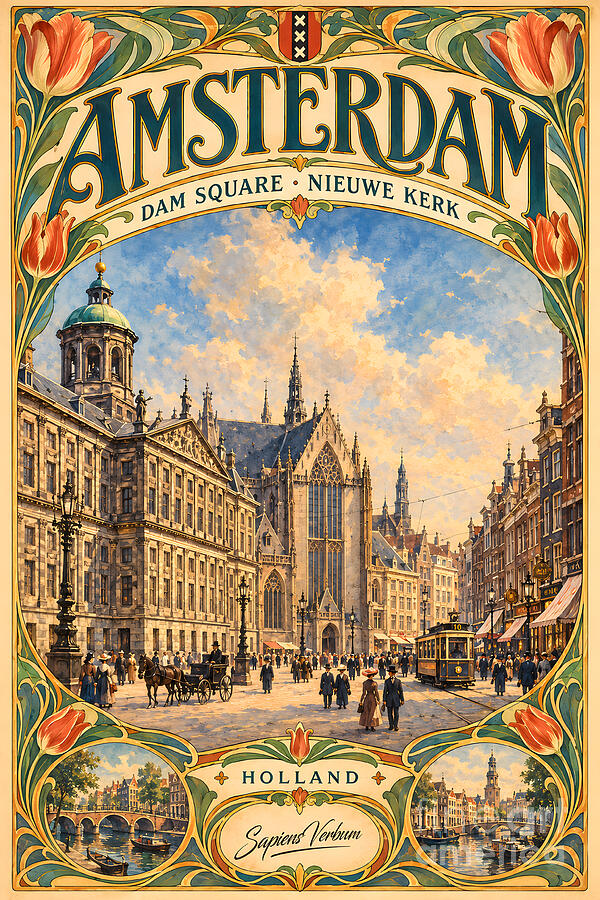
AMSTERDAM, in tall deep-teal capitals edged in gold, fills the top of the sheet, under the city’s arms: three white crosses on a black band across a red shield. Below, on a cream ribbon, come the words Dam Square and Nieuwe Kerk. Through an arch of green stems and red tulips, the Gothic church rises in warm stone under a summer sky, with the long classical front of the Royal Palace and its domed cupola on the left and a row of tall merchants’ houses with striped awnings on the right. A tram glides across the square, a horse-drawn carriage waits by a lamp post and ladies in long dresses and gentlemen in top hats stroll over the cobbles. At the foot of the frame a panel reads Holland, between two small round views of canals with arched bridges and moored boats. This poster comes from a picture postcard of the Dam published in Amsterdam around 1900 by N. J. Boon and now in the Amsterdam City Archives.
🖼️ Get this poster as a print →
Original photograph: Dam, gezien naar de Nieuwe Kerk met rechts het Damrak (the Dam, looking towards the Nieuwe Kerk, with the Damrak on the right), picture postcard published by N. J. Boon, Amsterdam, about 1900; photographer not named (Amsterdam City Archives, PBKD00390000011; public domain)
Interpretation: Sapiens Verbum
Subject: Dam Square with the Nieuwe Kerk, the Royal Palace and the corner of the Damrak, with trams and street life
Location: Dam Square, Amsterdam, Netherlands
Medium: Art Nouveau travel-poster interpretation of a public-domain postcard photograph
Lettering: AMSTERDAM · Dam Square · Nieuwe Kerk · Holland · Sapiens Verbum
Series: Vintage Travel Posters from Old Photographs
This poster treats its source more freely than most in the series. The postcard looks across the Dam at an angle: the great traceried window of the Nieuwe Kerk on the left, a tall corner building with balconies and awnings in the middle, and the shops at the head of the Damrak on the right, with people crossing the open square in front. The poster keeps the church, the open cobbled space, the awnings and the crowd, then steps back to show the whole square, bringing in the Royal Palace on the left and a long row of gabled houses on the right. A tram and a carriage arrive, the grey card turns to honey-coloured stone and blue sky, and the dark coats become light summer dresses. The frame is pure Art Nouveau, whiplash stems in green and gold, with red tulips in the corners and the arms of the city at the top, and the two little roundels at the foot add what every visitor to Amsterdam comes for: water, bridges and boats.
A dam, a square and a city
Amsterdam takes its name from this spot. Around 1270 a dam was built across the river Amstel, the first link between the settlements on its two banks, and a document of 1275, in which Count Floris V of Holland granted a toll privilege to the people living “at the dam in the Amstel”, is the first record of the town. As the dam was built up it became wide enough to be a square, with a fish market where ships moored to unload, and locks let boats pass between the dammed river and the new harbour beyond it, the Damrak. The Damrak was partly filled in during the nineteenth century, and by the time of the postcard the Dam was surrounded by land on every side. In the days of the horse tram, at the end of the nineteenth century, it was the most important tram junction in the city (Dam Square).
The building on the left of the poster was not built for a king. Amsterdam raised it as its new city hall, with Jacob van Campen in charge of the work from 1648, on a foundation of 13,659 wooden piles, and it was opened in 1655. It became a royal palace only in 1808, when Louis Bonaparte, made King of Holland by his brother Napoleon, moved to Amsterdam and took the city hall as his residence. He had the old weigh house on the square demolished because it spoiled his view. After 1815 the building became a palace of the Dutch royal house, and it is still used by the King for state visits and receptions (Royal Palace of Amsterdam).
The new church that is six hundred years old
The Nieuwe Kerk was “new” only in comparison with the Oude Kerk, the Old Church, which had grown too small for the expanding town. With the permission of the Bishop of Utrecht, building began around 1380, and the church was consecrated in 1409 to St Mary and St Catherine. It was damaged by the city fires of 1421 and 1452, burned almost entirely in 1645 and was rebuilt in Gothic style, and in 1578 it became a Dutch Reformed church. When the postcard was published it was in the middle of a long restoration, from 1892 to 1914, that added many of the neo-Gothic details you see today. Admiral Michiel de Ruyter and the poet Joost van den Vondel are buried here, and the church is the place where Dutch monarchs are inaugurated: Queens Wilhelmina, Juliana and Beatrix, and King Willem-Alexander in 2013 (Nieuwe Kerk, Amsterdam).
The photograph behind it
The source is a picture postcard, the most popular way of sending a view home in the years around 1900. It was published by N. J. Boon of Amsterdam, whose imprint, Uitg. N. J. Boon, Amst., runs up the left edge of the picture, and the photographer is not named. The caption below the view reads Dam (Bisschop) and Amsterdam, and someone has written a few words in ink underneath and signed them “Betsy”. The view is taken from above the square, looking past the corner of the Damrak towards the Nieuwe Kerk, its slender roof spire rising behind the gable. On the right, a shopfront carries the name of Justus van Maurik, the Amsterdam writer and cigar maker who kept a cigar shop on the Damrak (Justus van Maurik jr.). The Amsterdam City Archives date the card to about 1900, and it is in the public domain (Amsterdam City Archives, PBKD00390000011, via Wikimedia Commons). The poster keeps the church, the square and the crowd, and adds the palace, the summer, the colour and the tram.

Seeing the view today
The Dam lies in the heart of the old city, about 750 metres south of Centraal Station along the Damrak, and several tram lines still cross it, as they did when the postcard was made. Stand on the east side of the square, near the National Monument, and you have the poster’s view: the Royal Palace across the way, the Nieuwe Kerk to its right and the Damrak opening off on your right towards the station. The nearest metro station is Rokin. The Nieuwe Kerk no longer holds services and is used for exhibitions and organ recitals, and the public rooms of the Royal Palace are open to visitors on most days of the year; both publish their opening times on their official websites.
The series continues with Vienna, The Staatsoper and the Ringstrasse, made from a stereo photograph of 1906, Paris, The Eiffel Tower and the Trocadéro, Venice, The Grand Canal and Santa Maria della Salute and Amalfi, From the Cappuccini, all made from photochroms of the 1890s, and Lisbon, Praça do Comércio and the Tagus, and began with Fene, Paisaje de Maniños, a poster made from a 1932 postcard of the Ría de Ferrol.
Bring Belle Époque Amsterdam to your wall in the style of a golden-age travel poster. This Art Nouveau poster of Dam Square and the Nieuwe Kerk is available as a museum-quality print, canvas or poster, and it can also be licensed for your own project.
 Buy Fine Art Print
License Photograph
Buy Fine Art Print
License PhotographBrowse the full collection →
Printed and shipped by Fine Art America · 30-day money-back guarantee
See Dam Square and the Nieuwe Kerk on Google Maps
Part of the Vintage Travel Poster series.
Comments
Post a Comment