Paris, The Eiffel Tower and the Trocadero: Vintage Travel Poster from an 1890s Photochrom
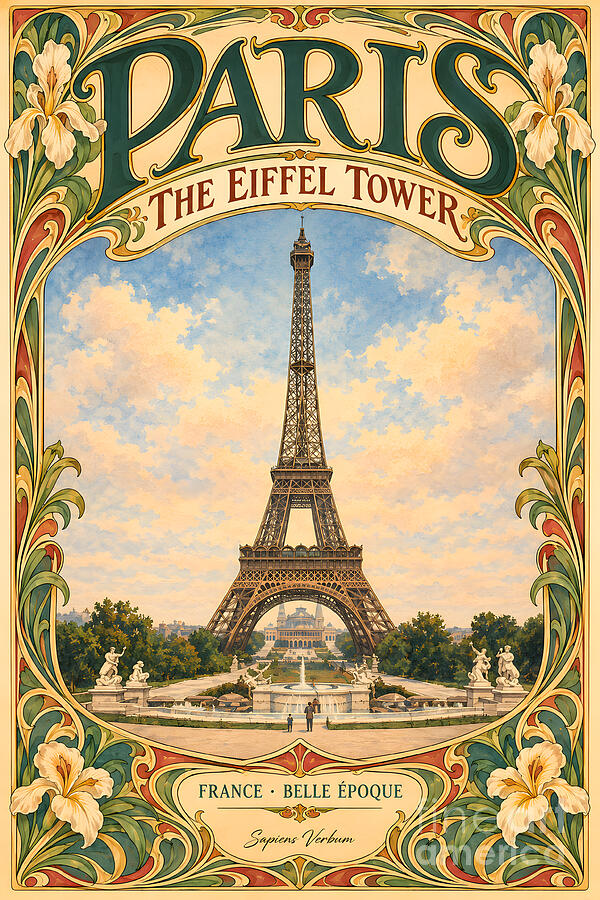
PARIS, in tall bottle-green capitals, fills the top of the sheet, and below it, in deep red on a cream ribbon, come the words The Eiffel Tower. Through an arch of sweeping green and red leaves and white irises, the tower rises in full view against a sky of soft summer clouds, its iron lattice climbing high above the trees. Beneath its great arch, far away across the river, stands the domed Palais du Trocadéro, and in the foreground a fountain with white statues at its corners spreads its basin across the gardens, while two small figures stroll on the sand. At the foot of the frame a scroll reads France · Belle Époque. This is the fourth poster in our series of vintage travel posters made from old photographs, and its source is a colour print of Paris sold to travellers in the 1890s.
🖼️ Get this poster as a print →
Original photograph: Photochrom print, between ca. 1890 and ca. 1900 (print no. 1052, marked “P.Z.”, Photochrom / Photoglob Zürich)
Interpretation: Sapiens Verbum
Subject: The Eiffel Tower in full view, looking toward the Palais du Trocadéro, with a fountain on the Champ de Mars
Location: Champ de Mars, Paris, France
Medium: Art Nouveau travel-poster interpretation of a public-domain photochrom
Lettering: PARIS · The Eiffel Tower · France · Belle Époque · Sapiens Verbum
Series: Vintage Travel Posters from Old Photographs
The poster follows the photochrom closely, because the view hardly needs changing: it is one of the most perfectly composed views in Europe, the tower on the axis of the Champ de Mars with the Trocadéro framed under its arch. What the poster changes is the sky and the season. In the old print the sky is a smooth evening wash, apricot near the horizon and fading to blue-grey above; the poster fills it with high summer clouds and greens the trees around the fountain. The lone figure standing before the basin in the photochrom becomes a pair of strollers. The frame is pure Art Nouveau: whiplash stems in sage, rust and gold, sweeping leaves, and white irises in the corners. The iris is a fitting flower for Paris. Since at least the eighteenth century, writers have argued that the fleur-de-lis, the emblem of the French kings, was a stylized iris rather than a lily, and fleurs-de-lis still crown the coat of arms of the city (Fleur-de-lis).
A tower for a centenary
The Eiffel Tower was built as the centrepiece of the Exposition Universelle of 1889, the world’s fair held to celebrate the hundredth anniversary of the French Revolution. Its design is attributed to two senior engineers of Gustave Eiffel’s company, Maurice Koechlin and Émile Nouguier, who in 1884 sketched “a great pylon” of four lattice girders meeting at the top; the head of the company’s architecture department, Stephen Sauvestre, added the decorative arches at the base and other ornaments. Work began on 28 January 1887, the main structure was finished at the end of March 1889, and at 300 metres the tower became by far the tallest structure ever built, a title it kept until the Chrysler Building in New York was completed in 1930 (Eiffel Tower).
It was not built to last. Eiffel’s contract gave him the income from the tower for the Exposition and the following twenty years, after which it was due to pass to the City of Paris and could be dismantled. Before it was even up, a group of leading artists and writers, among them Charles Garnier, Guy de Maupassant and Charles Gounod, published a protest in Le Temps against “this useless and monstrous Eiffel Tower”. The public disagreed: the Exposition drew more than 32 million visitors between May and October 1889 (Exposition Universelle of 1889), and nearly two million of them went up the tower. When the concession ran out in 1909 the tower survived because it had become useful, above all as an aerial for the new radio telegraphy. In the photochrom the tower is coloured a reddish brown, close to the colour it was first painted.
The palace that vanished
The building under the arch is the part of this view that no longer exists. The Palais du Trocadéro was built between 1876 and 1878 on the hill of Chaillot for the previous world’s fair, the Exposition Universelle of 1878, to designs by Gabriel Davioud and Jules Bourdais. It was an eclectic building of Moorish and neo-Byzantine inspiration: a great rotunda holding a 4,600-seat concert hall, flanked by two towers over 80 metres high and extended by two long curving wings. Below it, gardens by Adolphe Alphand ran down to the Seine around a cascade guarded by four gilded animals, an elephant, a rhinoceros, a horse and an ox. The palace served the Expositions of 1889 and 1900 as well, and in 1889 Le Figaro advised visitors that the best way to take in the whole fair was to stand in the palace’s central gallery and look out across the river (Trocadéro Palace).
Unlike the tower, the Trocadéro never won Paris over. Critics mocked its style, its decoration was not built to last and its hall had famously poor acoustics. Marcel Proust could still write of its “giraffe-necked towers”, but from 1935 the central rotunda and the two towers were demolished, and for the Exposition of 1937 the wings were wrapped in the new Palais de Chaillot, with an open esplanade where the rotunda had stood (Palais de Chaillot). Some of its sculpture survives. The six gilded statues of the continents that stood on its terrace, and three of the four animals from its cascade, were set up in 1985 on the forecourt of the Musée d’Orsay, where they greet visitors today; the ox went to Nîmes.
The photograph behind it
The source is a photochrom, the colour process invented in the 1880s by Hans Jakob Schmid of the Swiss printing firm Orell Füssli and published under the imprint Photochrom Zürich, later Photoglob Zürich. A black-and-white negative was transferred to a set of lithographic stones, one for each colour, and the prints were sold at tourist sites and by mail order to travellers (Library of Congress, The Photochrom Process). We told the story of the process in more detail in our Venice poster.
This print carries its caption along the lower left edge: 1052. P.Z. – Paris La Tour Eiffel. The initials P.Z. mark prints produced by Photochrom and Photoglob Zürich. It is preserved in the Photochrom Print Collection of the Library of Congress, which gives it the descriptive title Eiffel Tower, full-view, looking toward the Palais du Trocadéro, Paris, France, dates it between about 1890 and 1900, chose it for its 2013 ebook Great Photographs from the Library of Congress, and states that there are no known restrictions on reproduction (LCCN 2001698582, digital file LC-DIG-ppmsc-05221). The camera stood on the Champ de Mars, south-east of the tower, looking north-west along the axis of the gardens to the Trocadéro on the far bank. The poster keeps the tower, the palace, the fountain and its statues, and adds the frame, the lettering and a summer sky.

Seeing the view today
You can still stand where the photographer stood. Walk into the Champ de Mars from the south-east and look back along the gardens: the tower rises straight ahead, and under its arch, across the Seine, you now see the pale wings of the Palais de Chaillot instead of the domed rotunda. The nearest stations are Bir-Hakeim on the Metro and Champ de Mars–Tour Eiffel on the RER. For the reverse view, cross the Pont d’Iéna to the esplanade of the Palais de Chaillot, the spot where the old palace stood. And when you visit the Musée d’Orsay, stop on the forecourt to greet the continents and animals that once looked down on this view from the Trocadéro.
Inside the Orsay and the Louvre, our guide to paintings you can see in Paris on Sapiens Verbum Art lists the pictures we have explained room by room. The series began with Fene, Paisaje de Maniños, an Art Nouveau poster made from a 1932 postcard of the Ría de Ferrol, and continued with Venice, The Grand Canal and Santa Maria della Salute and Pontedeume, The Eume River and Bridge, the first poster made from a photograph of our own.
Bring Belle Époque Paris to your wall in the style of a golden-age travel poster. This Art Nouveau poster of the Eiffel Tower and the vanished Palais du Trocadéro is available as a museum-quality print, canvas or poster, and it can also be licensed for your own project.
 Buy Fine Art Print
License Photograph
Buy Fine Art Print
License PhotographBrowse the full collection →
Printed and shipped by Fine Art America · 30-day money-back guarantee
See the Eiffel Tower on Google Maps
Part of the Vintage Travel Poster series.
Comments
Post a Comment