Pontedeume, The Eume River and Bridge: Vintage Travel Poster from Our Own Photograph
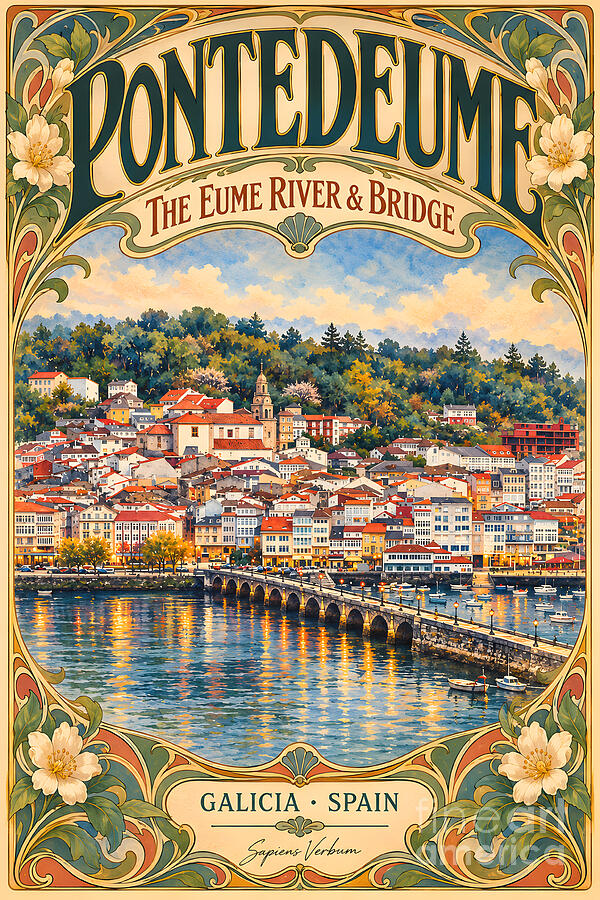
PONTEDEUME, in tall bottle-green capitals, fills the top of the sheet, and below it, on a cream ribbon, come the words The Eume River & Bridge. Through an arch of leaves and creamy white blossoms the town opens out in the warm light of evening. White and ochre houses with terracotta roofs climb the hillside in tiers, a church tower rises among them, and above the last roofs the woods run up to the skyline. Along the waterfront the lamps are lit, and in front of the town the long stone bridge strides across the estuary on its round arches, every light doubled in the water, while small boats lie at their moorings. At the foot of the frame a panel reads Galicia · Spain. This is the third poster in our series of vintage travel posters, and the first one made not from an archive print but from a photograph of our own, taken by Sapiens Verbum.
🖼️ Get this poster as a print →
Original photograph: Medieval Fishing Town of Pontedeume with Its Stone Bridge by Night, by Sapiens Verbum
Interpretation: Sapiens Verbum
Subject: The town of Pontedeume climbing its hillside above the stone bridge over the Eume estuary
Location: Pontedeume, A Coruña, Galicia, Spain
Medium: Art Nouveau travel-poster interpretation in a watercolour and lithographic style
Lettering: PONTEDEUME · The Eume River & Bridge · Galicia · Spain · Sapiens Verbum
Series: Vintage Travel Posters from Old Photographs
The poster keeps the photograph’s view almost house for house and changes the hour. The camera recorded the town after dark, with a black hillside and a sky that had already gone; the poster brings the light back into the sky, turns the clouds to cream and apricot over a blue that is just beginning to fade, and lets the woods show their greens again, with a few trees in pink blossom among them. The lamps, though, stay lit, and their reflections still run down into the estuary as long gold strokes, so the picture sits somewhere between evening and night, the moment when a town looks most welcoming from across the water. The bridge is shortened to fit the sheet, and the boats are gathered in its shelter. The frame is pure Art Nouveau: whiplash curves in sage, rust and gold, a white blossom in each corner, and at the top and the bottom a fan-shaped scallop shell. The shell is more than an ornament here. The scallop has been the badge of the pilgrims to Santiago since the Middle Ages, and the pilgrims of the English Way still cross this very bridge on their way to Compostela.
The bridge that named the town
Pontedeume simply means “the bridge on the Eume”, and the name is older than the town itself: a crossing called Ponte de Eume appears in documents of 1162, and on 30 December 1270 Alfonso X granted a charter to found a town at the place “que dizen ponte deume”. At the end of the fourteenth century Fernán Pérez de Andrade, O Boo, lord of these lands, replaced the old crossing with a great stone bridge of 78 arches, with two towers, a cross at its end and, between two of its arches, the stone bear and boar of the Andrade family. In 1393 he founded a hospital on the bridge itself to look after the pilgrims on their way to Santiago (Pontedeume, Galipedia).
The bridge in the poster is its successor. The medieval bridge was worn out by floods and repairs, and in the second half of the nineteenth century it was demolished and replaced by the present stone bridge of fifteen arches, which still follows the old line into the town. We told that story, with the legend of the bear and the boar, in The Bridge at Pontedeume, c. 1900–1930.
A pilgrim road and a pilgrim shell
The English Way, or Camino Inglés, was the route of the pilgrims who reached Galicia by sea, from England, Ireland, Scandinavia and the rest of northern Europe, landing at Ferrol or A Coruña and walking south to Santiago. It flourished during the Hundred Years’ War, when English pilgrims and traders sailed to the Galician ports with the permission of their Crown, and Pontedeume was one of the places with a known pilgrim hospital along the way (English Way). Today it is the fourth most walked route to Santiago, and almost everyone who walks it starts in Ferrol and crosses the Eume on this bridge.
The scallop shell on the poster belongs to that road. Pilgrims returning from Compostela carried home a Galician scallop shell as proof that they had completed the journey, and over time the shell became the badge of the pilgrim and the waymarker of the Camino (Camino de Santiago). In that sense it was an early travel souvenir, and a travel poster is, in a way, its distant descendant: a picture of a place to take home and put on the wall.
The archbishop’s tower
The tower that rises above the roofs, in the photograph and in the poster, belongs to the parish church of Santiago. The first church was built by Fernando de Andrade in the sixteenth century, and it was rebuilt between 1757 and 1763 by the builder Alberto Ricoy, to plans by Manuel de los Mártires, on the initiative of a son of the town (Iglesia de Santiago, Puentedeume). That son was Bartolomé de Rajoy y Losada, born in Pontedeume in 1690 and archbishop of Santiago from 1751 to 1772, who learned his Latin in the town’s own grammar school and became one of the great builders of eighteenth-century Galicia (Bartolomé de Rajoy). In Santiago he commissioned the palace that closes the Praza do Obradoiro opposite the cathedral, the Pazo de Raxoi, begun in 1766 and today the city hall. So the tower of Pontedeume and the square where every pilgrim’s journey ends were raised by the same man.
From photograph to poster
Travel posters and photographs have always worked together. In Spain the state began promoting tourism with the Comisaría Regia del Turismo, created by royal decree in 1911 under the Marqués de la Vega-Inclán, which brought heritage and travel together and in 1914 presented “Sunny Spain” at a tourism exhibition in London (Comisaría Regia del Turismo). Its successor from 1928, the Patronato Nacional de Turismo, published guides and leaflets for every Spanish province and books and posters on the country’s monuments, illustrated with pictures by the leading photographers of each place, such as Ksado in A Coruña (Patronato Nacional de Turismo). The poster begins as a photograph, and the artist decides what to keep, what to move and what to light.
Pontedeume is made for that treatment. It is one of the few Galician towns that keeps its historic centre, with arcades, wooden balconies and glazed galleries, and in 1971 the Eume district was declared a historic ensemble and picturesque landscape (Pontedeume, Galipedia). Seen from across the estuary it composes itself like a poster: water in the foreground, the long horizontal line of the bridge, the town stacked up the slope and a single tower to hold the eye.
The photograph behind it
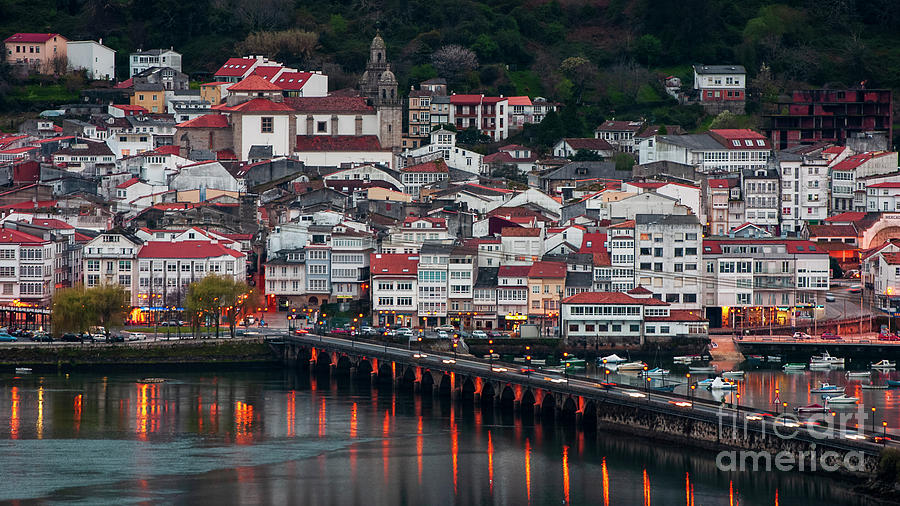
The source is a photograph by Sapiens Verbum, taken from across the Eume after nightfall. The sky has gone dark, the trees on the hill are almost black, and the town is lit from within: windows, shopfronts and the street lamps along the waterfront. The water is calm, so the lamps of the bridge fall into the estuary as clean orange lines. We have already turned this frame into a loose watercolour, which you can see next to the photograph in Pontedeume’s Medieval Stone Bridge by Night. The poster keeps the town, the tower, the bridge, the boats and the reflections, and adds the frame, the lettering and the last light of the day.
Get the original photograph as a print →
Visiting Pontedeume today
The best view of the poster’s scene is from the far bank of the Eume, on the Cabanas side, or from the bridge itself, which can be crossed on foot. Come at dusk, when the lamps along the quay and the bridge come on and the town begins to glow above the water. Then cross into the old town, climb the steep streets to the church of Santiago, and look for the Torreón dos Andrade, the last remnant of the Andrade palace, which now houses the tourist office. Upriver, the Eume leads into the Fragas do Eume natural park and the monastery of Caaveiro.
For more of Pontedeume, see the stone bridge by night and the bridge on a postcard of c. 1900–1930, the Tree Festival in Praza do Conde, c. 1914, Pontedeume from Cabria, Nogueirosa and fishermen repairing nets on the quay. Upriver, the Eume runs below the monastery of Caaveiro. The series continues with Venice, The Grand Canal and Santa Maria della Salute.
Bring the Eume estuary to your wall in the style of a golden-age travel poster. This Art Nouveau poster of Pontedeume and its bridge is available as a museum-quality print, canvas or poster, and it can also be licensed for your own project. The original night photograph is available as a print too.
 Buy Fine Art Print
License Photograph
Buy Fine Art Print
License PhotographBuy the Original Photograph
Browse the full collection →
Printed and shipped by Fine Art America · 30-day money-back guarantee
See the bridge of Pontedeume on Google Maps
Part of the Vintage Travel Poster series.
Comments
Post a Comment