Sunset over Ronda Bridge: The Puente Nuevo and El Tajo Gorge in Golden Light
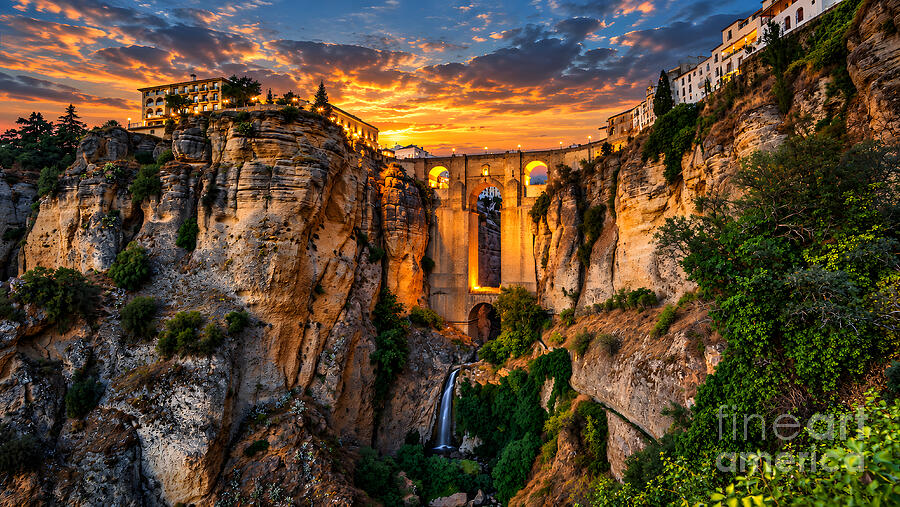
At sunset the gorge of Ronda turns to gold. Two walls of sandstone drop away into the Tajo, the deep cut carved by the Guadalevín river, and between them stands the Puente Nuevo, a wall of stone from the river bed to the rooftops, its windows and arches lit from within. Houses and hotels line the cliff edges on both sides, a thin waterfall falls into the shadows below, and above it all the sky burns orange, red and violet. It is the most famous view in Ronda.
🖼️ Get this photograph as a print →
Photographer: Sapiens Verbum
Subject: The Puente Nuevo (New Bridge) over El Tajo gorge at sunset, seen from below
Location: Puente Nuevo, Ronda, Málaga, Andalusia, Spain
The bridge: about 98 metres high, built 1759–1793 of stone quarried in the gorge itself
Series: Andalusia
A bridge that took 34 years
Ronda sits on a rock split in two by the Tajo. For centuries the old walled town and the newer quarter across the gorge were joined only by older, lower bridges, the Arab Bridge and the Old Bridge. In the eighteenth century the town decided to cross at the top. The first attempt, a single arch begun in the 1730s, was badly built and collapsed a few years later, killing some fifty people.
The second attempt was approved in 1751 and work began in 1759. Several master builders followed one another on the site until, in 1785, José Martín de Aldehuela, the architect of the San Telmo aqueduct in Málaga, took charge of the works. A local builder, Juan Antonio Díaz Machuca, devised machines to lower materials to the bottom of the gorge. The bridge was opened to pack animals and carriages on 4 November 1787 and finished in 1793, after 34 years of work. It stands about 98 metres from the bottom of the gorge to the top, and it is built of “Ronda stone” cut from the river bed below, which is why, in this photograph, bridge and cliff glow in exactly the same colour.
Reading the photograph
The frame is built like a theatre. The two cliff faces close in from left and right like curtains, and the bridge stands at the back of the stage, framed by the gorge. The low sun lights the sandstone from the side, so every ledge and crack of the rock is drawn in gold and shadow, while the lit windows of the bridge and its upper arches glow as if the stone were hollow. Above the central arch is the chamber that was used over the years for several purposes, among them as a prison; today the old guard-house beside it holds an exhibition on the history of the bridge. Below, the thin white line of the waterfall leads the eye down into the dark green of the gorge, and the clouds above repeat the warm colours of the stone.
If you go, this angle is found on the paths that lead down into the gorge below the bridge. Arrive an hour before sunset: the light moves quickly, and the moment when the stone turns gold lasts only a few minutes.
For more of Andalusia at the golden hour, see Arcos de la Frontera at dusk, another white town on a cliff, Triana Bridge in Seville on a summer evening and Saint Sebastian Castle at sunset in Cádiz.
Bring the golden light of Ronda home: this photograph of the Puente Nuevo at sunset is available as a museum-quality print, canvas or poster, and it can also be licensed for your own project.
 Buy Fine Art Print
License Photograph
Buy Fine Art Print
License PhotographPrinted and shipped by Fine Art America · 30-day money-back guarantee
See the Puente Nuevo on Google Maps
💬 Over to you: Would you rather see the Puente Nuevo from the bottom of the gorge, as here, or walk across it at the top? Tell us in the comments.
Part of the Andalusia series.
Sources
Turismo de Ronda — Centro de Interpretación Puente Nuevo
Wikipedia (Spanish) — Puente Nuevo (Ronda)
Wikipedia — Puente Nuevo
Comments
Post a Comment